
Why Your Family's Health Records Should Belong to You—Not Stay Trapped in Silos
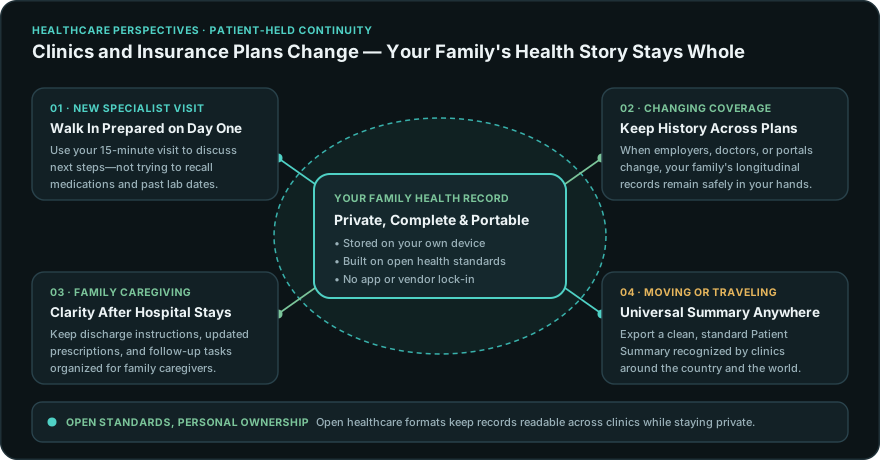
Consider how fragmented medical records remain compared with almost every other part of daily life.
If you switch banks, you take your financial statements with you. If you change phone carriers, you keep your number and your photos. Yet in healthcare, a person's lifelong medical history is routinely divided across separate systems depending on which employer they worked for in 2019, which insurance network covered them in 2023, and which hospital happened to be closest during an urgent visit last month.
Each clinic or hospital maintains the official medical record for the care delivered within its own practice. The gap appears between organizations. The patient and the family caregiver are the only people present at every step along the journey, yet they have historically lacked simple, dependable tools to carry that history forward.
Here is why Spectrayan is investing deeply in portable, patient-held health records inside Carefold—and why that shift matters just as much for busy physicians and clinics as it does for families at home.
1. Four Life Moments Where Scattered Records Fail Families
Fragmented records rarely feel urgent when everyone is healthy and seeing one doctor year after year. They become painful during the exact moments when families are already stretched thin:
- Stepping In to Care for an Aging Parent: After an unexpected ER visit or hospital stay, adult children often step in overnight to help manage a parent's recovery—only to discover medications prescribed by three different specialists that have never been reconciled on one page.
- Changing Jobs or Insurance Plans: When an employer switches health plans, families frequently have to change primary-care networks. Years of baseline labs, vaccine dates, and medication history stay locked inside the old clinic's portal while the new clinic hands you a blank clipboard in the waiting room.
- Seeing a Specialist for a Complex Issue: When you wait two months for a twenty-minute specialist consultation, spending the first twelve minutes trying to remember dates of prior imaging or which medications caused side effects three years ago wastes precious clinical time.
- Moving Cities or Traveling: Whether a college student moves out of state or retirees split the year between two regions, an up-to-date summary of conditions, allergies, and active prescriptions should travel reliably with them.
2. How Open Healthcare Standards Help Everyday Families
For decades, even when a patient asked for a copy of their records, they were handed either a stack of faxed paper or a CD-ROM that no home computer could open.
Today, healthcare around the world has converged on open, universal digital standards—most notably HL7 FHIR (a shared format that lets different medical systems exchange structured records like medications, allergies, immunizations, and lab results accurately) and the International Patient Summary (a globally recognized format for an essential clinical summary).
Until recently, those standards were mostly used behind the scenes by large hospital networks and enterprise software vendors. With Carefold's upcoming Personal Health Chart update, we are bringing those same universal standards directly to individuals and families—without requiring any technical background to use them:
- Readable by Families Today, Compatible With Clinics Tomorrow: You see organized medication lists, clear lab trend charts, and labeled clinic sources—while underneath, Carefold preserves standard healthcare formatting so your records remain accurate and shareable with future providers.
- No Vendor Lock-In: Patients should not have to trade hospital portal silos for application lock-in. Because Carefold stores and exports standard healthcare records on your own device, your family's history remains yours to keep, back up, or bring to a new clinic.
3. Better Prepared Families Make Better Clinical Visits
When patients and caregivers arrive organized, both families and clinicians benefit.
Ask almost any primary-care physician, specialist, or nurse what slows down an outpatient visit, and they will point to the same friction: missing outside lab results, uncertainty about which prescriptions a patient is still taking at home, and rushed last-minute questions as a hand is already on the exam-room doorknob.
When a caregiver walks in with:
- A reconciled, source-labeled list of active medications and allergies,
- Two weeks of consistent morning and evening home blood-pressure readings, and
- Three clear, prioritized questions staged ahead of time,
a fifteen-minute visit shifts from reconstructing basic history to focused, attentive care.
How Carefold Fits Into Spectrayan's Vision for Care
Across Spectrayan, our goal is to make healthcare software calmer, clearer, and more connected for families organizing care at home with Carefold.
Carefold's latest family-care release is available today, and our Personal Health Chart update bringing multi-portal record sync to your device is arriving soon. Earlier in this series, you can read Meet Carefold, how Carefold keeps clear clinical boundaries, and our Personal Health Chart preview. Visit our Carefold product page to explore how it works, or reach out to our team if you are a clinic, caregiver organization, or healthcare partner interested in collaborating.