
Under the Hood: Hardening Durability & Spiking Hypergraph Traversal in Spector
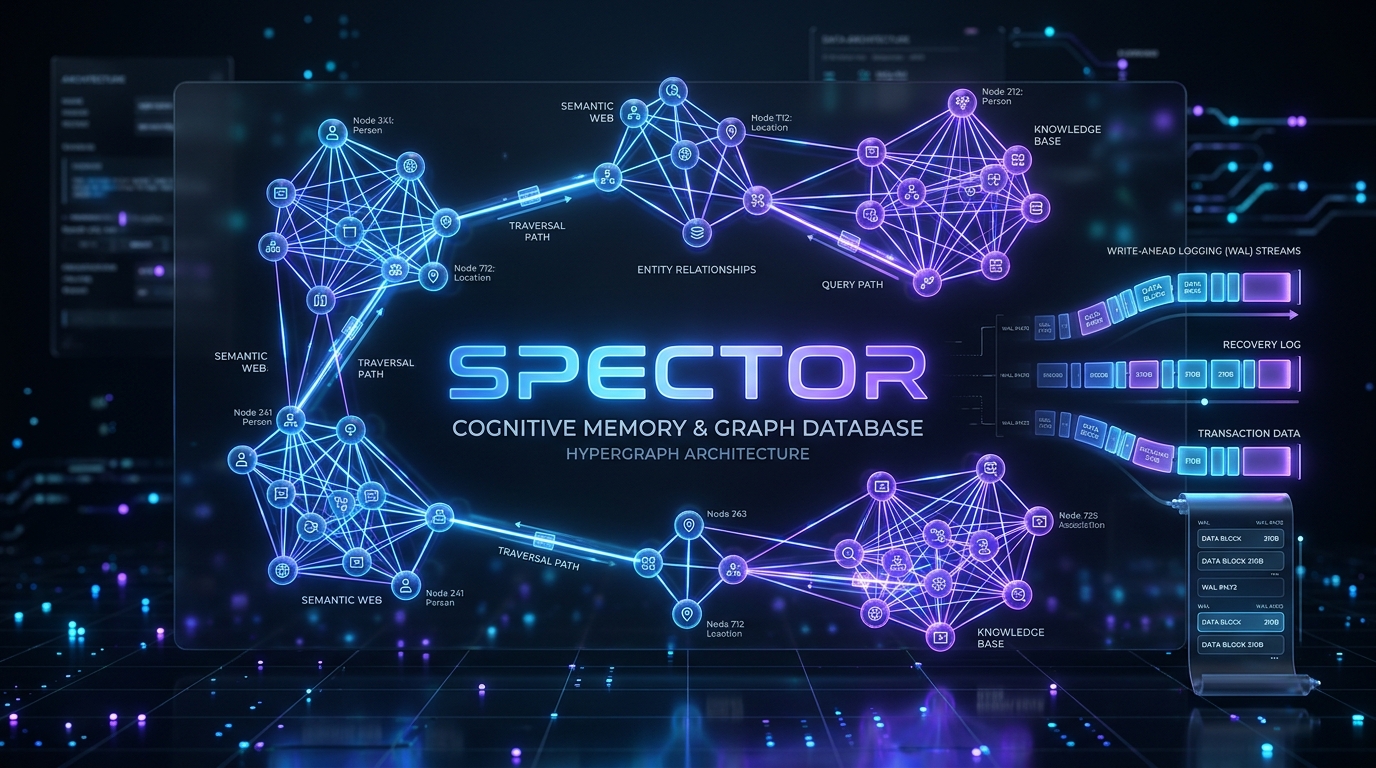
In the quest to build biologically-inspired cognitive memory for autonomous AI agents, performance cannot come at the cost of correctness. Over the past 24 hours, the Spector team has successfully hardened the persistence layer of our graph databases and wired up an experimental recall traversal spike for n-body hypergraphs.
Here is a technical deep dive into what was built, what was fixed, and how we verified it.
1. Hardening Durability: The WAL Binding Gap (Issue #417)
Spector leverages a Write-Ahead Log (WAL) to ensure that all memory updates—including synaptic changes, temporal chain links, and entity-relation mutations—are durable. During a routine architectural audit of SpectorMemoryFactory.java, we discovered a silent durability vulnerability:
WARNING
While both EntityGraphMemory and HebbianGraphMemory were writing mutations to the WAL when configured, the production memory factory was not calling bindWal(wal) on startup. In production, WAL writes were bypassed, making graph mutations vulnerable to loss in the event of an ungraceful crash.
We resolved this by modifying the factory startup sequence to explicitly bind the production instances of entityGraph and hebbianGraph to the Write-Ahead Log prior to processing recall operations:
// SpectorMemoryFactory.java
entityGraph.bindWal(wal);
hebbianGraph.bindWal(wal);
2. Proving Correctness: The Round-Trip Recovery Test
To ensure that the WAL binding behaves correctly under crash scenarios, we implemented a full write-close-reload-assert round-trip integration test within our new HypergraphRecallSpikeTest suite:
sequenceDiagram
participant App as Client Application
participant Graph as Entity/Hebbian Graph
participant WAL as Write-Ahead Log
participant Disk as Off-Heap/Local Storage
App->>Graph: Mutate node/edge
Graph->>WAL: Log WalEvent (ADJ_ADD_EDGE)
WAL->>Disk: Flush log sector
Note over App, Disk: --- PROCESS CRASH / TERMINATION ---
App->>Graph: Reopen fresh/empty instances
App->>WAL: Open recovery WAL
WAL->>App: Replay events (0 to HWM)
App->>Graph: Dispatch mutations via WalRecoveryDispatcher
Note over Graph: Graphs fully reconstructed!
This test case:
- Performs mutations (adds entities, defines relations, links entity IDs to memory indices, and strengthens Hebbian synaptic weights).
- Closes the WAL to guarantee all buffered log frames are flushed to disk.
- Spawns fresh, completely empty instances of the graphs (representing the cold restart state).
- Re-opens the WAL and runs the
WalRecoveryDispatcherto replay all logged transactions. - Asserts that the empty target graphs are fully reconstructed with identical topological structure and weights.
This round-trip test has successfully eliminated any future risk of regression in WAL serialization behavior.
3. Spiking N-Body Hypergraphs: Collapsing Graph Overhead (Issue #418)
Standard knowledge graphs represent relations in binary pairs (e.g., A -> B and A -> C). However, episodic memories are n-body events connecting multiple entities, contexts, and roles. Storing n-body relations as binary pairs leads to exponential edge explosion during spreading activation.
To address this, we spiked HyperEntityGraphMemory, which collapses pairwise edges into unified hyperedges:
$$H_e = \{v_1, v_2, \dots, v_n\}$$
We implemented a recursive multi-hop hyperedge traversal:
// HyperEntityGraphMemory.java
public Set<Integer> collectMemories(int startEntity, int maxHops) {
    Set<Integer> visitedEntities = new HashSet<>();
    Set<Integer> collectedMemories = new HashSet<>();
    traverseRecursive(startEntity, 0, maxHops, visitedEntities, collectedMemories);
    return collectedMemories;
}
We then wired the HyperEntityGraphMemory directly into the RecallPipeline and the GraphExpansionStage under a newly introduced, default-off policy flag: useHypergraphRecall.
4. The Path Forward: Decoupled Gated Evaluation
Now that the wiring is merged, we are entering the evaluation phase. Because double-writing to both binary graphs and hypergraphs incurs ingest, decay, and serialization overhead, we are executing a strict, metrics-driven benchmark:
- The Recall@K Benchmark: We will benchmark the retrieval precision of the hypergraph path versus the binary graph path on a representative corpus.
- The Keep/Gate/Retire Decision:
- IF the hypergraph path demonstrates a statistically significant recall advantage, we will proceed with full off-heap kernel-conformance (custom SMKM header layouts, flat buffers, and serializers).
- IF the performance gains are marginal, we will turn off
hyperEntityGraphEnabledby default to preserve computational efficiency, leaving the code dormant.
In the meantime, our next engineering epic transitions to Spectral Sparsification (#416)—leveraging effective resistance estimation via uniform spanning trees to prune weak Hebbian edges during sleep consolidation, ensuring Spector remains fast, light, and biologically accurate.
Spector is open-source. Explore the architecture on GitHub.