
Zero-Downtime Memory Migration: Binding Subsystem Codecs in Spector
As AI agents run continuously over months and years, the underlying storage layout of their cognitive memory must evolve without losing historical context or forcing manual database migrations. In enterprise AI systems, requiring an offline migration tool every time a memory schema upgrades is unacceptable.
In our latest Spector Memory Kernel (SMK) milestone—Phase 3C: Subsystem Codec Binding, Global Registry & Factory Wiring—we completed a major architectural upgrade: transparent, zero-downtime forward migration of off-heap memory files upon opening.
In this technical post, we explore how Spector binds domain-specific Codec<L> implementations, uses a global CodecRegistry sniffer, and transparently upgrades legacy binary layouts on startup.
1. The Challenge of Evolving Off-Heap Layouts
Prior to Phase 3, Spector utilized distinct layout formats for its biological memory tiers:
TPCH(v1): Chronological temporal chainsTXT1(v1): Variable-length text append blobsTREG(v1): Type registry definitionsMIDX(v4): Multi-tenant index recordsHGPH(v2): Hebbian graph co-activation matrices
As we unified all storage under the 64-byte SMKM binary header specification in Phase 1 & 2, legacy files on disk needed to upgrade to SMKM headers and Little-Endian byte order seamlessly.
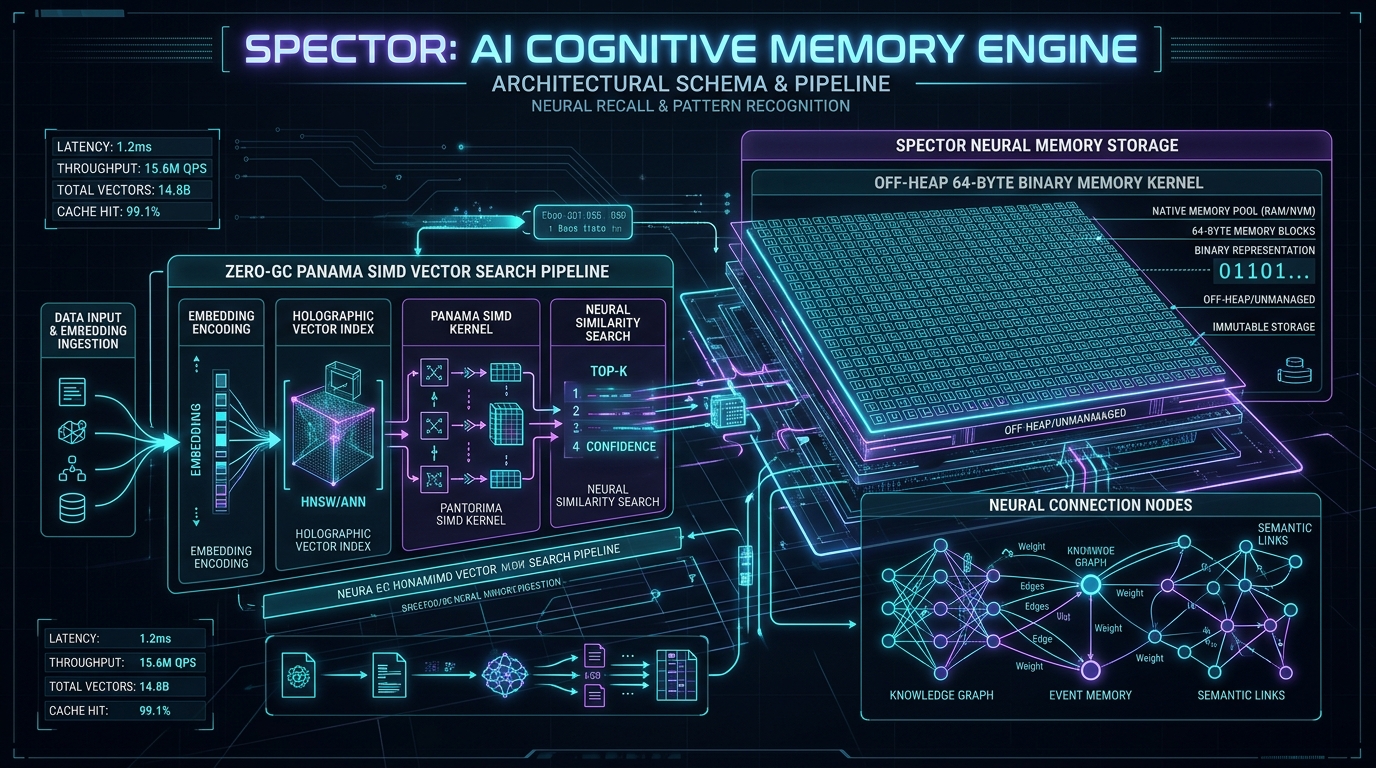
2. The Codec Architecture & Domain Bindings
The Codec<L> contract encapsulates a memory layout (MemoryLayout) together with its list of ordered migration steps (CodecStep) and supported legacy magic numbers:
graph TD
Factory["SpectorMemoryFactory"] --> Reg["Codecs.defaultRegistry()"]
Reg --> TPCH["TemporalChainCodec"]
Reg --> TXT["TextAppendCodec"]
Reg --> TREG["TypeRegistryCodec"]
Reg --> MIDX["IndexRecordCodec"]
Reg --> HGPH["HebbianGraphCodec"]
TPCH --> Step1["TpchToSmkmStep: TPCH v1 to SMKM v2"]
TXT --> Step2["LegacyTextToSmkmStep: TXT1 v1 to SMKM v1"]
TREG --> Step3["TregToSmkmStep: TREG v1 to SMKM v1"]
MIDX --> Step4["MidxToSmkmStep: MIDX v4 to SMKM v1"]
HGPH --> Step5["HgphToCsrStep: HGPH v2 to SMKM v1"]
The 5 Domain Codec Implementations:
TemporalChainCodec: HandlesTemporalLayout(TPCHmagic0x54504348). Upgrades legacy 16-byte temporal headers to 64-byteSMKMv2 headers.TextAppendCodec: HandlesTextBlobLayout(TXT1magic0x54585442). Upgrades legacy append pools toSMKMv1.TypeRegistryCodec: HandlesRegistryLayout(TREGmagic0x54524547).IndexRecordCodec: HandlesIndexEntryLayout(MIDXmagic0x4D494458).HebbianGraphCodec: HandlesHebbianLayout(HGPHmagic0x48475048). Upgrades legacy co-activation matrices into off-heap Compressed Sparse Row (CSR) matrices.
3. Global Registry Sniffing & Transparent Factory Auto-Migration
When an application or autonomous agent opens a memory file via SpectorMemoryFactory, Spector sniffs the file's first 64 header bytes using Java 25 Foreign Function & Memory (FFM) unaligned access:
sequenceDiagram
participant Agent as AI Agent / Factory
participant Sniffer as FormatDetector
participant Codec as Subsystem Codec
participant Step as RewriteFileStep
participant Target as Off-Heap SMKM File
Agent->>Sniffer: Open memory file
Sniffer->>Sniffer: Sniff header bytes (JAVA_INT_UNALIGNED)
alt Header matches SMKM
Sniffer-->>Agent: Ready (No migration needed)
else Legacy Magic Detected
Sniffer->>Codec: Resolve CodecChain (e.g. TPCH v1 to SMKM v2)
Codec->>Step: Execute atomic rewrite (Atomic rename & header upgrade)
Step->>Target: Write 64-byte SMKM header & copy payload
Step-->>Agent: Return MigrationResult (migrated=true)
end
By wiring Codecs.ensureCurrent(...) directly into SpectorMemoryFactory.java, legacy format files are automatically detected, safely upgraded in-place using atomic temporary file swaps, and returned to caller code with zero breaking changes.
4. Verification & Quality Gates
- Unit & Integration Tests:
SubsystemCodecIntegrationTestvalidates automatic step detection, atomic file swapping, and payload integrity. - Reactor Compatibility: All 26 modules compile cleanly under Java 25 with 0 failures across 1,150+ tests.
Check out the full open-source implementation on GitHub: 👉 GitHub Repository: https://github.com/spectrayan/spector