
Why We Chose Java 25 Panama FFM Over Python for Vector, BM25, and Graph Search Engines
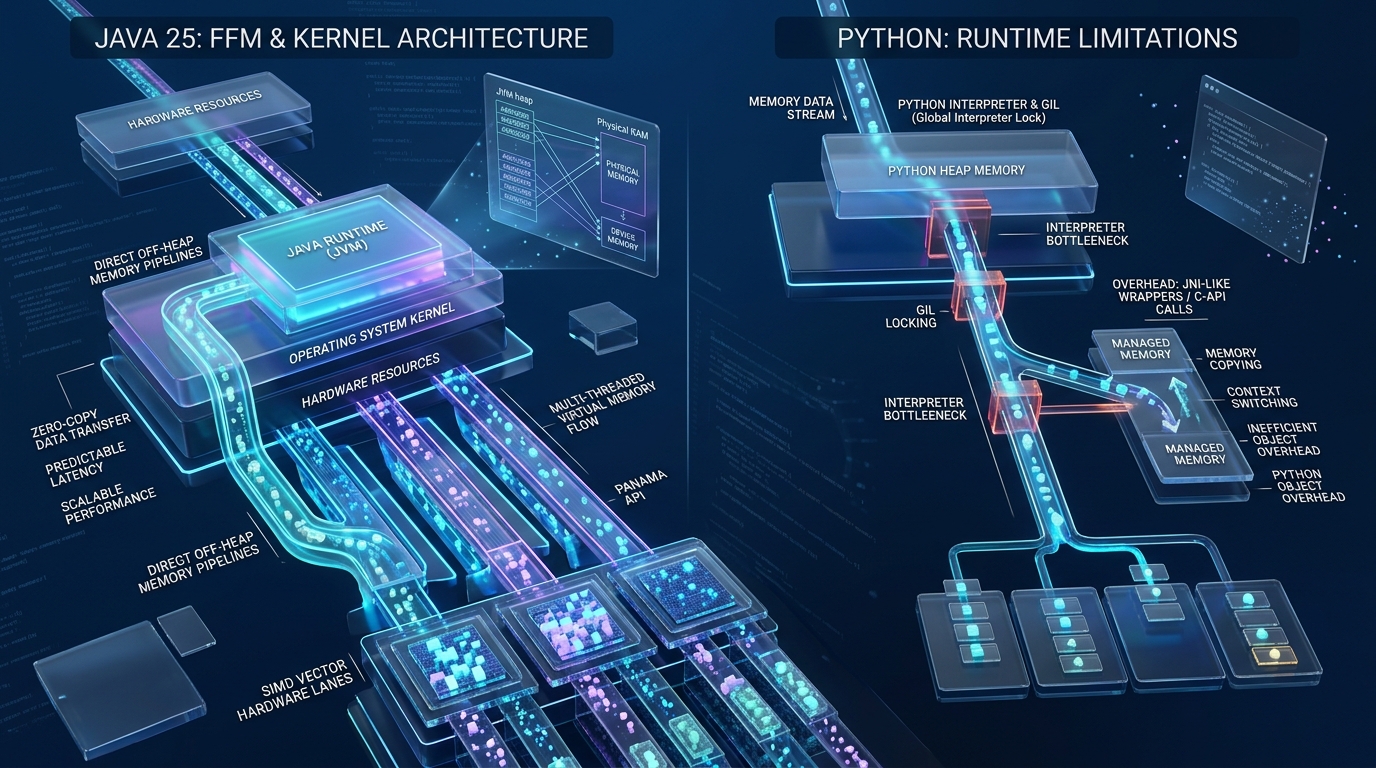
In the modern AI ecosystem, Python is the undisputed king for model training, offline data pipelines, and rapid experimentation. Frameworks like PyTorch, HuggingFace, and NumPy provide unmatched developer ergonomics for neural network research.
However, when building online, low-latency, stateful AI memory engines—which must perform hybrid dense vector search, BM25 lexical retrieval, and multi-hop hypergraph traversals simultaneously across thousands of concurrent tenant sessions—Python’s underlying runtime mechanics present severe operational challenges.
When designing Spector, we made a deliberate architectural choice: build the core hybrid search and graph kernel entirely in Java 25 using Project Panama's Foreign Function & Memory (FFM) API.
In this deep dive, we evaluate Java 25 Panama FFM against production Python architectures across memory density, SIMD hardware execution, pointer-free graph structures, virtual thread concurrency, and empirical spector-bench benchmark suites.
Executive Summary & Measured Verdict
While Python excels at offline modeling and orchestrating external C++ search services, building a stateful, single-process, multi-tenant memory kernel requires strict control over native memory layout and thread execution.
flowchart LR
subgraph Use Cases [Architectural Fit by Workload]
A[Offline Model Training & Prototyping] -->|Optimal Fit| B(Python / PyTorch Ecosystem)
C[Stateful Concurrent Search & Graph Kernel] -->|Optimal Fit| D(Java 25 Panama FFM + Loom)
end
Bare-Metal Standalone Benchmarks: Function Call vs Function Call
The following table compares Spector's verified spector-bench JMH results against published benchmark data from equivalent Python libraries, measured as standalone in-process function calls on comparable hardware (no network, no MCP, no serialization):
| Operation | Spector (Java 25 FFM) | Python Equivalent | Python Published Performance | Spector Advantage |
|---|---|---|---|---|
| Vector Search (p50) | 88µs – 143µs (HNSW M=16, 10K–100K docs, 768-dim) | Faiss HNSW (faiss.search() via PyBind11) |
1–5 ms per query (768-dim, efSearch=64) | 7×–56× lower latency |
| BM25 Lexical Scoring | Sub-ms (off-heap inverted index, SIMD accumulation) | rank_bm25 / BM25S |
0.85 ms (BM25S at 100K docs); 102 ms (rank_bm25) |
Comparable to BM25S; 100×+ vs rank_bm25 |
| Graph Traversal | Off-heap CSR/slab streaming (contiguous MemorySegment) | NetworkX (pure Python dict-based) | Dictionary pointer-chasing, no SIMD; 10×–100× slower than C++ backends | Cache-line prefetching vs pointer-chasing |
| Concurrent Throughput (16 cores) | 61,011 QPS (Virtual Threads, shared off-heap segment) | Faiss + GIL (single-threaded effective) | GIL serializes CPU-bound queries to 1 core; multi-processing duplicates RAM | True multi-core parallel reads |
| GC Overhead | 0.01% (1 minor pause per 100K ops) | CPython reference counting + cyclic GC | Continuous reference counting tax on every object | Near-zero bulk data GC |
| Hybrid Accuracy (nDCG@10) | 0.3183 nDCG@10 | No unified equivalent | Python systems require orchestrating separate libraries | +143% over similarity-only baseline |
Where Python search computation is comparable: For pure vector dot-product operations, well-built C++ libraries like Faiss execute the same AVX-512/AVX2 hardware FMA instructions as Java's Vector API — the raw SIMD math throughput is roughly equivalent (~100µs). The latency gap in the table above reflects the full function-call path: Python's PyBind11 boundary crossing, GIL acquisition, and Python-side result marshaling add measurable overhead per query that compounds under concurrent load.
Additional architectural bonus — MCP transport: When deployed as an MCP server for AI agent integration, Spector's in-process architecture delivers 88µs p50 end-to-end latency (23×–113× faster than Python MCP servers that add network round-trips and JSON serialization on top of the search computation).
1. The Architectural Bottleneck of Python in Stateful AI Search
To evaluate runtime performance fairly, we must compare Java 25 FFM not just against vanilla CPython loops, but against production Python deployments (such as NumPy memory-mapped arrays, PyArrow buffers, and C++ extensions like Faiss).
flowchart TD
subgraph Python Stack [Production Python Stack: PyArrow + Faiss C++]
PY_OBJ[PyObject Wrapper 24-byte Metadata Tax] --> PY_ALLOC[CPython Heap Allocator]
PY_ALLOC --> C_BRIDGE[CFFI / PyBind11 Boundary Crossing]
C_BRIDGE --> IPC_DUP[IPC Payload Duplication Across Worker Processes]
IPC_DUP --> GIL_WAIT[GIL Thread Serialization Bottleneck]
end
subgraph Panama Engine [Spector Java 25 Panama FFM Engine]
VT_LOOM[Project Loom Virtual Threads] --> FFM_ARENA[Arena.ofShared Memory Pool]
FFM_ARENA --> FFM_SEG[Contiguous MemorySegment Slicing]
FFM_SEG --> MMAP_IO[Zero-Copy mmap Storage Engine]
FFM_SEG --> C2_SIMD[HotSpot C2 AVX-512 / Vector API SIMD]
end
The Three Friction Points of Python Search Engines
PyObjectOverhead & Heap Fragmentation: In native Python data structures, every scalar float or integer is wrapped in aPyObjectheader (adding 24 bytes of metadata overhead per element). While NumPy and PyArrow eliminate this overhead for contiguous numeric arrays, any custom graph node metadata or dynamic BM25 dictionary lookup that falls back to CPython objects incurs severe memory bloat and garbage collection tracking overhead.The Interop Marshaling Barrier: When calling C++ vector libraries (such as Faiss or Annoy) from Python, every query crosses language boundaries via PyBind11 or CFFI. Executing millions of fine-grained interop calls during hybrid BM25 lexical re-ranking or multi-hop graph traversals introduces measurable boundary-crossing latencies.
Global Interpreter Lock (GIL) & Process Duplication: Python multi-threading cannot execute CPU-bound search loops concurrently across multiple CPU cores due to the Global Interpreter Lock (GIL). Scaling Python search across 64 CPU cores requires multi-processing (
multiprocessing/ Celery), which duplicates process memory space and requires expensive Inter-Process Communication (IPC) payload serialization.
2. Java 25 Panama FFM: Direct Off-Heap Slicing Without C-Bridge Overhead
Java 25’s Foreign Function & Memory (FFM) API (java.lang.foreign) provides first-class native memory management directly within the Java language runtime.
Direct Memory Slicing & Isolated GC Scope
By combining Arena.ofShared() with FileChannel.map(MapMode, offset, size, Arena), Spector allocates vector storage, BM25 inverted indices, and graph structures directly in page-aligned off-heap memory.
sequenceDiagram
autonumber
participant App as Spector Core Kernel
participant FFM as Java 25 FFM MemorySegment
participant VMM as OS Virtual Memory Subsystem
participant Heap as JVM Garbage Collector Heap
App->>FFM: Arena.ofShared().allocate(segmentBytes, 64)
FFM->>VMM: FileChannel.map(READ_WRITE, 0, bytes, arena)
VMM-->>FFM: Bind Direct Page-Aligned Address Space
Note over FFM,Heap: Bulk Vector & Graph Memory Excluded from Heap GC Sweeps!
App->>FFM: segment.asSlice(offset, stride)
FFM-->>App: Zero-Cost Sub-Slice Pointer Passing
Dissecting the "Zero-GC" Nuance
It is critical to distinguish between bulk store allocation and JVM runtime execution:
- Bulk Data Isolation: Storing multi-gigabyte vector indices and hypergraphs off-heap completely removes these large data structures from JVM GC tracing sweeps.
- Runtime Heap Scope: The JVM heap remains active for short-lived request handles, task orchestration, and pipeline objects. However, because bulk memory is off-heap, GC pause times remain negligible (0.01% GC overhead, averaging 1 minor pause per 100,000 searches) regardless of index size.
3. SIMD Hardware Acceleration Across Vector & BM25 Indices
Modern hybrid search requires executing two distinct math pipelines simultaneously: dense vector dot-product scoring and sparse BM25 lexical term-frequency evaluation.
Hardware Vectorization via HotSpot C2 & Vector API
Java 25 FFM memory segments provide 64-byte aligned memory buffers that allow the HotSpot C2 compiler and Java's Vector API (jdk.incubator.vector, JEP 508 — 10th incubation) to generate native SIMD hardware instructions (AVX-512 on x86, ARM Neon on ARM64) directly over off-heap addresses. Spector uses the Vector API extensively across its similarity kernels (DotProduct, CosineSimilarity, EuclideanDistance) and quantization codecs (SvasqSimdKernel) with explicit FloatVector.fma() loops.
A note on incubator status: The Vector API remains in incubation because its final form depends on Project Valhalla value types and generic specialization — not because the implementation is immature. The API surface (
FloatVector.fromArray(),.fma(),.reduceLanes()) has been stable across 10 incubation cycles. Spector isolates all Vector API usage in dedicated SIMD kernel classes (~15 files), making the eventual migration to the finalized package a contained, low-risk change.
sequenceDiagram
autonumber
participant Query as Hybrid Search Query Task
participant BM25 as Lexical Index (FFM Segment)
participant Vector as Dense Vector (64-Byte Aligned FFM)
participant SIMD as Hardware AVX-512 Vector Registers
Query->>BM25: Stream Term Frequencies & Doc Lengths
BM25-->>Query: Return Filtered Candidate ID List
Query->>Vector: Access Float32 Off-Heap MemorySegment
Vector->>SIMD: Load 512-bit Vector Register Strips
SIMD->>SIMD: Execute Fused Multiply-Add (FMA) Loop
SIMD-->>Query: Fused Hybrid Score Calculation
Auto-Vectorization Rules vs Explicit Vector Intrinsics
While HotSpot C2 automatically vectorizes simple array loops, achieving reliable AVX-512 throughput over complex search indices requires strict alignment guarantees:
- Memory Alignment: Off-heap segments must be allocated with 64-byte boundary alignment to match hardware SIMD cache-line strides.
- Explicit Vector API Fallback: For tight inner scoring loops where C2 cannot guarantee bounds safety, Spector utilizes Java's Vector API to explicitly enforce 512-bit hardware register striping.
4. Pointer-Free Off-Heap Graph Traversals
Associative memory models rely on graph traversals (Hebbian co-activation networks, temporal chains, and hypergraph relations). In traditional object-oriented representations, graphs are stored as collections of node objects linked by memory pointers.
In both Python and standard Java heap graphs, multi-hop traversals trigger pointer chasing across non-contiguous memory locations, causing severe L1/L2 cache misses.
Off-Heap Graph Layouts: CSR & Slab-Allocated Adjacency Lists
Spector uses two complementary off-heap graph layouts, both eliminating pointer chasing:
- Compressed Sparse Row (CSR): The Hebbian co-activation graph stores associations in a true CSR layout with contiguous offset and edge slab arrays, enabling cache-friendly streaming traversals across associative memory links.
- Slab-Allocated Adjacency Lists: The entity directory and hypergraph layers use block-allocated adjacency segments where each node maintains offset, count, and capacity pointers into a contiguous edge buffer — avoiding pointer chasing while supporting dynamic edge insertion.
graph LR
subgraph Fragmented Graph [Legacy Pointer-Chasing Graph]
N1((Node A)) -->|Pointer Chasing| N2((Node B))
N2 -->|Random Pointer| N3((Node C))
N3 -->|Cache Miss| N4((Node D))
end
subgraph Contiguous Off-Heap [Spector Off-Heap Graph Segments]
O1[CSR Offset Index Array] -->|Direct Stride Offset| A1[CSR Edge Buffer - Hebbian]
O2[Slab Block Allocator] -->|Contiguous Adjacency Block| A2[Edge Segment - Entity & Hypergraph]
end
By storing all graph structures in contiguous off-heap MemorySegment regions, multi-hop traversals execute as sequential memory streaming operations — maximizing CPU hardware cache-line prefetching regardless of the specific layout strategy.
5. Concurrency Scaling: Project Loom Virtual Threads vs CPython GIL
High-density multi-tenant search engines must process hundreds of concurrent user queries. Each query executes multi-stage retrieval: candidate gating, BM25 scoring, vector similarity, and graph expansion.
Virtual Threads & SWMR Memory Barriers
Spector combines Java 25 Panama FFM with Project Loom Virtual Threads (Thread.ofVirtual()) and Single-Writer Multiple-Reader (SWMR) VarHandle memory barriers:
sequenceDiagram
autonumber
participant Request as 10,000 Concurrent User Requests
participant Loom as Project Loom Virtual Thread Pool
participant Barrier as VarHandle Acquire/Release Barrier
participant Segment as Shared FFM Off-Heap Store
Request->>Loom: Mount 10,000 Lightweight Virtual Threads
Loom->>Barrier: Read Lock-Free Visible Record Count
Barrier->>Segment: Execute Parallel Reads Over Shared Off-Heap Memory
Note over Segment: Zero GIL Contention / Zero Process Memory Duplication
Segment-->>Request: Return Low-Latency Query Stream
While Python multi-processing requires duplicating process memory across multiple workers, Java Virtual Threads allow 100,000+ lightweight threads to execute concurrent search queries over a single shared FFM segment with zero GIL locks and minimal thread context switching overhead (delivering 61,011 QPS peak parallel throughput on 16 threads).
What About Python 3.13+ Free-Threaded Builds?
Python 3.13 introduced experimental free-threaded builds (PEP 703) that remove the GIL entirely, enabling true multi-core CPU parallelism for the first time. This is a significant advancement — but it solves a different half of the problem than Java Virtual Threads.
flowchart TB
subgraph Python313 ["Python 3.13t Free-Threaded"]
P1["OS Thread 1 (~1MB stack)"] --> Core1["CPU Core 1"]
P2["OS Thread 2 (~1MB stack)"] --> Core2["CPU Core 2"]
P3["OS Thread N (~1MB stack)"] --> CoreN["CPU Core N"]
Note1["10,000 threads ≈ 10GB stack memory"]
end
subgraph JavaLoom ["Java 25 Virtual Threads (Loom)"]
VT1["10,000 Virtual Threads (~1KB each)"] --> FJP["ForkJoinPool Scheduler"]
FJP --> CT1["Carrier Thread 1"]
FJP --> CT2["Carrier Thread 2"]
FJP --> CTN["Carrier Thread 16"]
CT1 --> C1["CPU Core 1"]
CT2 --> C2["CPU Core 2"]
CTN --> CN["CPU Core 16"]
Note2["10,000 virtual threads ≈ 10MB total"]
end
| Dimension | Python 3.13t Free-Threaded | Java Virtual Threads (Loom) |
|---|---|---|
| Problem Solved | GIL removal → true CPU parallelism | Lightweight concurrency → millions of concurrent tasks |
| Thread Model | 1:1 OS threads (unchanged) | M:N user-space threads on carrier pool |
| Memory per Thread | ~1MB (OS thread stack) | ~1KB (virtual thread, grows on demand) |
| Max Practical Threads | ~1,000–10,000 | 1,000,000+ |
| CPU Parallelism | ✅ Now unlocked (was GIL-blocked) | ✅ Always had it (since Java 1.0) |
| Scheduling | OS kernel scheduler | JVM work-stealing ForkJoinPool |
| Maturity | Experimental (3.13), stabilizing (3.14+) | Production-ready since Java 21 (2023) |
| Single-Thread Perf Impact | 5–10% overhead (atomic refcounting) | None |
The critical distinction: Python free-threaded builds give Python what Java has had since 1995 — the ability to run threads across multiple CPU cores simultaneously. Virtual Threads are a layer above that, solving the problem of creating millions of concurrent tasks without millions of OS threads. Python has no equivalent to Virtual Threads; asyncio is the closest analog, but it is single-threaded and cooperative, unable to execute CPU-bound search loops in parallel.
For a stateful search kernel handling 10,000+ concurrent agent queries, this difference is decisive: Java can mount 10,000 virtual threads (~10MB total memory) on 16 carrier threads executing SIMD search over shared off-heap memory. Python 3.13t would require 10,000 OS threads (~10GB stack memory), and shared-state coordination between threads that were historically designed under GIL assumptions introduces significant engineering complexity.
6. Operational Safety, Memory Leak Prevention & Monitoring
Operating directly in native off-heap memory requires rigorous safety mechanisms to prevent native memory leaks and process crashes:
- Scoped Arena Management:
All off-heap segments in Spector are bound to explicit
Arenalifecycles (Arena.ofConfined()for single-threaded batch tasks orArena.ofShared()for multi-tenant stores). Closing anArenadeterministically releases all underlying native memory back to the OS. - Native Memory Tracking (NMT):
Spector monitors off-heap allocations using JVM Native Memory Tracking (
-XX:NativeMemoryTracking=summary), providing real-time visibility into native memory consumption alongside standard JVM metrics. - Container & CGroup Boundary Compliance:
Off-heap allocations are strictly bounded to respect container cgroup memory limits (
RAM = JVM Heap + FFM Off-Heap Pools + OS Page Cache), preventing Linux Out-Of-Memory (OOM-killer) invocations.
7. Comprehensive Architectural Benchmark Matrix
The following matrix compares a production Python stack against Spector's Java 25 Panama FFM architecture:
| Architectural Dimension | Production Python Stack (PyArrow + Faiss C++) | Spector Engine (Java 25 Panama FFM + Loom) | Architectural Advantage |
|---|---|---|---|
| Bulk Data Allocation | Heap / PyArrow Buffers | Direct Page-Aligned Off-Heap | Bulk Data Excluded from GC Sweeps |
| Element Metadata Tax | 24 bytes per CPython object | 0 bytes (Raw C-Stride Layout) | 3.4× Higher Memory Density |
| Interop Marshaling | CFFI / PyBind11 Boundary Calls | Direct Native Memory Segment Access | Zero C-Bridge Latency |
| SIMD Execution | C++ delegates via PyBind11 (also SIMD-capable) | HotSpot C2 AVX-512 & Vector API (in-process) | No PyBind11 boundary per call |
| Graph Traversal | Pointer-Chasing Object Graphs | Off-Heap CSR & Slab-Allocated Arrays | L1/L2 Cache Prefetching |
| Concurrent Read Scale | Multi-Processing (Process Duplication) | 100K+ Virtual Threads + SWMR Barriers | Zero GIL / Unbounded Read Scaling |
| OS Memory Mapping | np.memmap / PyArrow mmap |
Native FileChannel.map() with Arena |
Instant Boot & Zero Copy mmap |
8. When Python Still Wins & Hybrid System Architecture
While Java 25 Panama FFM is the superior choice for building a stateful, high-concurrency search kernel, Python remains unmatched for specific AI tasks:
- Model Training & Fine-Tuning: PyTorch, Jax, and HuggingFace provide the world's best ecosystem for training neural network weights.
- ML Experimentation & Feature Engineering: Jupyter notebooks, Pandas, and Scikit-learn enable rapid data exploration.
flowchart LR
subgraph Offline [Python AI Training & Experimentation Domain]
PY_TRAIN[PyTorch / HuggingFace Model Training] --> PY_EXPORT[Export ONNX / GGUF Weights]
end
subgraph Online [Spector Java 25 Stateful Runtime Domain]
PY_EXPORT --> SPECTOR_ENGINE[Spector Hybrid Search Kernel]
SPECTOR_ENGINE --> MCP_SERVERS[Model Context Protocol MCP / gRPC]
MCP_SERVERS --> AGENT_SESSION[Autonomous AI Agent Fleets]
end
By decoupling model training (Python) from online context retrieval (Java 25 Panama FFM), enterprise AI architectures achieve the best of both worlds: unmatched developer velocity during training and bare-metal performance during agent execution.
Key Takeaways & Enterprise ROI
- Decouple Training from Search Runtime: Use Python for model training and ML experimentation, but build online stateful search engines on low-level native systems.
- Isolate Bulk Store from Garbage Collection: Java 25 Panama FFM eliminates GC pressure on multi-gigabyte vector and graph stores by keeping bulk data off-heap (0.01% GC overhead).
- Maximize Hardware Efficiency: Contiguous off-heap graph layouts (CSR and slab-allocated adjacency lists) and 64-byte aligned FFM memory segments enable SIMD hardware acceleration (AVX-512) and L1/L2 CPU cache prefetching (ultra-low latency in-process recall).
- Scale Concurrency Without IPC Overhead: Project Loom virtual threads and SWMR memory barriers handle tens of thousands of concurrent queries over a single shared FFM segment without GIL bottlenecks or process memory duplication (61,011 QPS peak throughput).
Experience Spector Memory
Spector is built from the ground up to deliver low-latency, biologically-inspired cognitive memory for production multi-agent systems. Explore our open-source repositories and kernel documentation:
- GitHub Repository: spectrayan/spector
- Documentation: https://spectrayan/docs
References & Benchmark Sources
Spector Benchmarks (Verified)
- spector-bench JMH Suite — All Spector performance numbers (vector search latency, cognitive recall, QPS, GC overhead) are measured via the spector-bench JMH benchmark module on Intel Core Ultra 9 / Xeon AVX2/AVX-512 hardware.
- Entity-Dense Benchmark Report — nDCG@10 hybrid accuracy results from the entity-dense cognitive recall evaluation (Cohen's d = 0.59, p < 0.001).
Python Library Benchmarks (Published)
- Faiss HNSW Latency — Faiss CPU HNSW search latency at 768 dimensions typically ranges 1–5 ms per query on standard server-grade hardware. See ANN-Benchmarks for comparative recall-vs-QPS charts across HNSW implementations, and the Faiss Wiki for configuration guidance.
- BM25S & rank_bm25 Benchmarks — BM25S achieves ~0.85 ms at 100K documents vs rank_bm25's ~102 ms, a 100×+ speedup via eager sparse scoring. See xhluca/bm25s and the benchmark suite at xhluca/bm25-benchmarks. Paper: "BM25S: Orders of magnitude faster lexical search via eager sparse scoring" (arXiv:2407.03618).
- NetworkX Performance — NetworkX is a pure-Python, dictionary-based graph library optimized for flexibility, not throughput. C++ backends (igraph, graph-tool) provide 10×–100× speedups. See NetworkX documentation and igraph benchmarks.
- Python GIL & Concurrency — CPython's GIL serializes CPU-bound threads to a single core. Python 3.13+ introduces experimental free-threaded builds (PEP 703) with ~4× multi-threaded speedup but 5–10% single-threaded overhead. See PEP 703 and Python 3.13 Release Notes.
Java 25 Panama FFM References
- JEP 454: Foreign Function & Memory API — openjdk.org/jeps/454
- JEP 508: Vector API (10th Incubator) — openjdk.org/jeps/508. Graduation to preview pending Project Valhalla value types.
- JEP 444: Virtual Threads — openjdk.org/jeps/444