
The Codd Moment for AI Memory: Why Storage Topology is Not a Memory Model
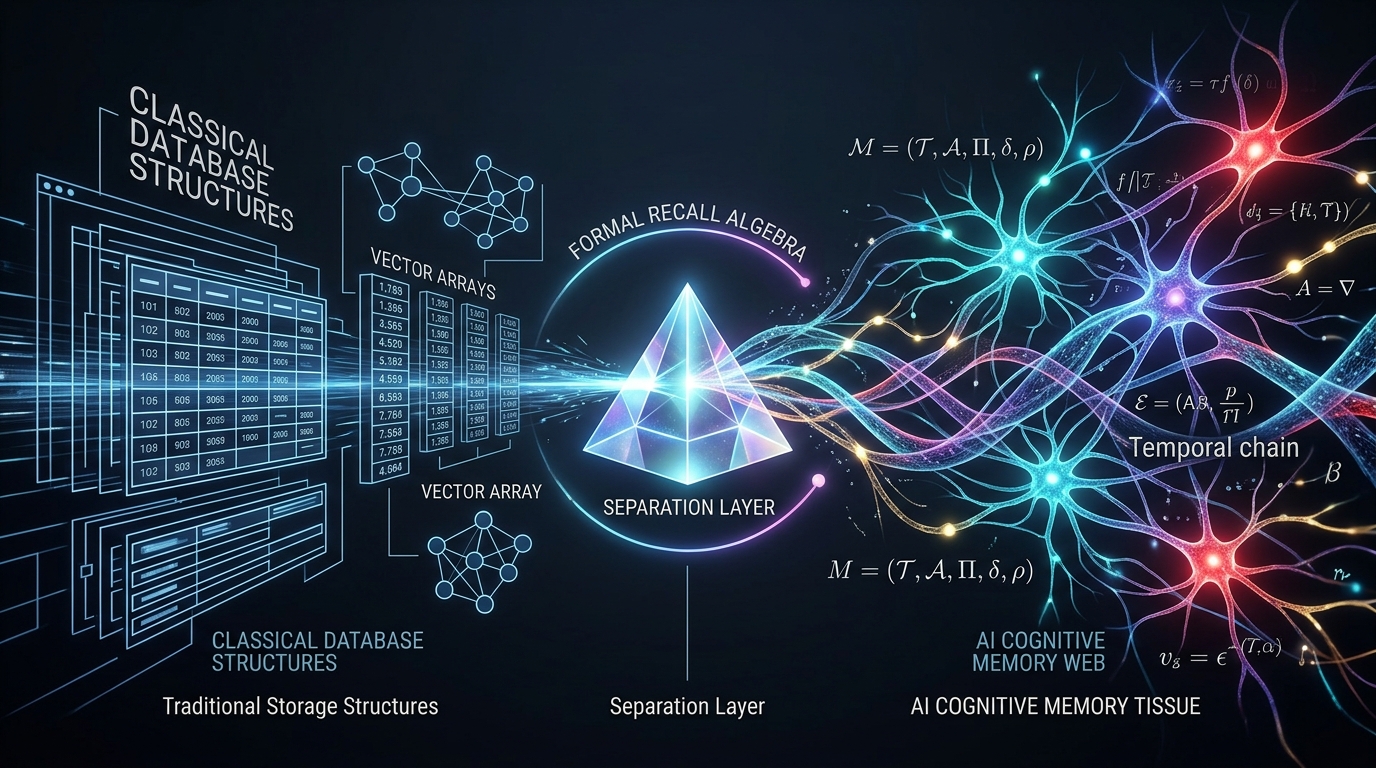
Executive Summary: The Pre-Codd Era of Agent Memory
In 1970, Edgar F. Codd published A Relational Model of Data for Large Shared Data Banks, rescuing software engineering from the tyranny of pointer chains, hierarchical trees, and network databases. Before Codd, data management was defined strictly by physical storage layout: if you changed how records sat on magnetic drums, every application query broke. Codd’s revolutionary insight was to decouple the data model and its closed algebra from the underlying physical access paths.
Today, the autonomous AI agent industry is trapped in its own pre-Codd era.
When modern frameworks claim to provide "agent memory," they almost universally describe a storage topology:
- A dense vector database wrapped with an ingestion-time summarization prompt.
- A property graph database queried alongside embedding cosine distance.
- Key-value scratchpads and JSON blocks injected into an LLM context window.
- An application orchestration layer that queries four distinct databases and stitches the JSON results together in Python.
Those are storage and orchestration patterns. None of them is a definition of memory.
+-------------------------------------------------------------------+
|                        THE FOUNDING DISTINCTION                   |
|                                                                   |
|   A database returns what was written.                            |
|                                                                   |
|   A memory engine reconstructs what is reachable from a cue       |
|   at this moment — under decay, association, and tier physics —   |
|   without losing a live trace because the first index was the     |
|   wrong one.                                                      |
+-------------------------------------------------------------------+
Today, we are open-sourcing the Memory Fundamentals Specification (MF-001) — a formal data model, closed 15-operation recall algebra, eight normal forms (NF0–NF7), and twelve empirical conformance rules (M0–M12) to establish the theoretical and engineering foundation for persistent cognitive memory engines.
The complete specification is publicly available on GitHub at spectrayan/memory-fundamentals.
1. Deconstructing the Database vs. Memory Divide
To build true generational intelligence for autonomous agents, we must first understand why adding layers of abstraction on top of traditional databases fails to create memory.
A biological brain is not a relational database, a document store, a graph database, or a vector index. It is one unified tissue that admits content-addressable, associative, sequential, and schematic views simultaneously.
The Architectural Triad of False Equivalences
- Storage $\neq$ Memory: In a database, a record is either present or deleted. In a memory engine, data possesses two distinct coordinates: Availability (whether the trace has been physically expunged) and Accessibility (whether the present cue can reach the trace inside a retrieval budget under decay and interference).
- Nearest-Neighbor $\neq$ Recollection: Semantic proximity is only one coordinate of recall. Without encoding salience, emotional arousal, temporal succession, Hebbian graph co-activation, and habituation suppression participating directly in candidate generation, retrieval collapses.
- Extract-on-Ingest $\neq$ Consolidation: Forcing raw conversational experience into rigid entity-relationship schemas at write time destroys subtle contextual nuances that may only become relevant months later. Memory requires continuous, lossy, lineage-tracked consolidation across distinct physical tiers.
2. The Truncation Trap: Mathematical Proof of Failure
The central engineering flaw of multi-database orchestration layers is what MF-001 formalizes as the Truncation Trap.
Consider a persistent agent with the following history:
- Three years ago: The user stated with high emotional importance and intense negative valence: "Never book red-eye flights under any circumstance."
- Last week: The user casually joked in passing about cheap overnight flights.
- Today: A new cue arrives: "Book my flight to London next Tuesday."
Ancient "never book red-eye" constraint has low cosine similarity Vec-->>App: Return Top-100 Candidates (Constraint Discarded!) App->>Scorer: Re-rank Top-100 by Importance & Rules Note over Scorer: The true constraint is permanently lost.
Post-ranking cannot score what was never retrieved. Scorer-->>User: Books a Red-Eye Flight (Critical Failure)
In a single-signal candidate generation pipeline (e.g., cosine top-$k$ followed by post-filtering or reranking), the ancient constraint is truncated before importance or emotional salience can ever be evaluated.
MF-001 Rule M2 (Guaranteed Access) establishes:
If a trace is available and passes the cue's hard gates, no retrieval plan may discard it before all first-class signals have participated in fused scoring.
3. The Formal Model: Traces, Cues, and State
MF-001 defines memory as an explicit mathematical domain:
$$ M = (\mathcal{T}, \mathcal{A}, \Pi, \delta, \rho) $$
Where:
- $\mathcal{T}$ is the set of all available traces across all cognitive tiers.
- $\mathcal{A}$ represents Hebbian, temporal, and hyperedge graph structures.
- $\Pi$ defines the tier physics (capacity bounds, durability, decay laws).
- $\delta$ maps traces to strength tuples $(D, S, \text{unresolved}, \ldots)$.
- $\rho$ is the isolated namespace of the rememberer.
The Trace $T$
An atomic stored engram is defined as:
$$ T = (\text{id}, \text{tier}, \text{payload}, \text{header}, \text{loc}) $$
+-------------------------------------------------------------------+
|                     64-BYTE SYNAPTIC HEADER                       |
+--------+--------+--------+--------+--------+--------+--------+----+
|  Flags | Valence| Arousal| Import |  Timestamp (ms) | Recall Count|
|  (1B)  |  (1B)  |  (1B)  |  (4B)  |      (8B)       |    (4B)     |
+--------+--------+--------+--------+--------+--------+--------+----+
| Storage Strength| Exact Norm      | Synaptic Tags (Bloom Filter)  |
|      (4B)       |     (4B)        |             (8B)              |
+--------+--------+--------+--------+--------+--------+-------------+
| Source Tag (closed enum) | Consolidation Lineage Pointer (8B)     |
+--------------------------+----------------------------------------+
The Cue $C$
A reconstruction request $C$ is a multi-dimensional probe:
$$ C = (\text{embedding}, \text{tags}, \text{valence-window}?, \text{time-window}?, I_{\min}?, \text{tier-mask}, k, \text{allow-simulated}, \text{context}) $$
Recall is a deterministic ranking function:
$$ R(C, M) \rightarrow [(T_i, s_i)] $$
Where $s_i$ is the fused multi-signal score computed across distance, emotion, time, and graph activation.
4. The 15-Operation Closed Recall Algebra
Just as Codd defined selection, projection, Cartesian product, join, and set difference, MF-001 defines a closed algebra where every operation takes $M$ and returns a mutated state $M'$ or a ranked reconstruction $[(T_i, s_i)]$.
| Operation | Returns Traces? | Rewrites Payload? | Updates Strengths? | Core Semantics |
|---|---|---|---|---|
remember |
No | N/A | Sets initial $D_0, S_0 \ge 1$ | Encodes payload, computes affective header, sets source = experienced. |
recall |
Yes | No | Yes ($D$ side-effect) | Signal-complete fused reconstruction against cue $C$. |
rehearse |
No (IDs only) | No | Yes ($\Delta S = s_{\text{gain}}(1-D)$) | Explicit reinforcement without leaking raw payload. |
reconsolidate |
Optional | Yes (with lineage) | Yes | The only lawful operation permitted to rewrite payload. |
associate |
No | No | No | Mutates Hebbian co-activation or temporal hyperedges. |
forget |
No | No | $D$ only; never $S$ | Lowers accessibility or writes tombstone. |
consolidate |
No | N/A | N/A | Lossy abstraction from episodic into semantic/procedural. |
inhibit |
No | No | No | Applies habituation or situational suppression. |
reinforce |
No | No | No | Blends outcome feedback into valence. |
project_tier |
Yes | No | No | Filters recall projection to a single physical regime. |
introspect |
No | No | No | Emits catalog-level distributions and accessibility diagnostics. |
simulate |
Yes (Hypothetical) | No | No | Read-only counterfactual rollout; returns source = simulated. |
dream |
No | No | May rehearse/associate |
Offline batch synthesis; generates hypotheses without minting autobiographical facts. |
commit_simulation |
No | N/A | N/A | Promotes selected hypotheses to distilled with full provenance DAG. |
5. Strength is Not Existence: The Bjork Two-Factor Model
Databases treat deleted records as non-existent and stored records as perpetually accessible. MF-001 borrows the empirical New Theory of Disuse (Bjork & Bjork, 1992) to govern machine forgetting:
- Retrieval Strength ($D$): Measures current accessibility. Decays monotonically with time and disuse; surges upon successful recall.
- Storage Strength ($S$): Measures structural durability. $S$ is strictly non-decreasing over the lifetime of a trace (except upon explicit cryptographic tombstone).
Accessibility (D) & Durability (S) Dynamics
Strength
  ^
1.0 |======== (Initial Encoding: D=1.0, S=1.0)
    | \
    |  \  Decay Curve of D
    |   \                   Rehearsal at low D:
    |    \                  Massive ΔS jump!
    |     \    +----------+
    |      \   | Rehearsal|
0.2 |.......\_/...........====== S grows to 2.4 (Higher Durability)
    |        \            \
    |         \            \ Slower decay of D due to higher S!
0.0 +-------------------------------------------------------------> Time
Desirable Difficulty
When an agent rehearses a trace whose retrieval strength $D$ has decayed significantly, the storage strength gain $\Delta S$ is maximized:
$$ \Delta S = s_{\text{gain}} \cdot (1 - D) $$
High storage strength $S$ acts as an insulator, dampening the future decay rate of $D$. Forgetting in a conformant memory engine is not data destruction—it is the adaptive attenuation of retrieval accessibility.
6. Normal Forms for Memory Integrity (NF0–NF7)
Just as relational normalization (1NF through 5NF) prevents update anomalies, MF-001 establishes eight Normal Forms to ensure cognitive integrity:
- NF0 — Single Engram: Vector embeddings, text payloads, affective headers, and graph edges share one immutable logical identity.
- NF1 — Header Completeness: Every factor evaluated during scoring must exist on the trace header or be a total function over $T$ and $C$.
- NF2 — Lineage of Distillation: Every semantic fact produced by
consolidatemaintains an auditable pointer DAG to the episodic source turns it collapsed. - NF3 — Rememberer Isolation (Shared-Nothing Persistence): The durable boundary of memory is the rememberer $\rho$. Traces from different agents must never share an authoritative table or index where isolation relies on a
WHERE tenant_id = 'A'query predicate. - NF4 — Association Well-Formedness: Graph edge endpoints must terminate on valid trace IDs within the same rememberer namespace.
- NF5 — Payload Honesty: Payload mutations via
reconsolidatemust preserve versioned history. Monotonic strength updates are tracked separately. - NF6 — Emotional Completeness: Episodic, semantic, and procedural traces must have defined valence, arousal, and importance at encoding.
- NF7 — Source Honesty: Every trace carries a closed source tag:
$$\text{Source} \in \{\text{experienced}, \text{distilled}, \text{simulated}, \text{rehearsed}\}$$
Offline dreaming and simulation must never forge an
experiencedautobiographical episode.
7. The Twelve Conformance Rules (M0–M12)
To evaluate whether a system is a genuine memory engine or a database wrapper, MF-001 defines twelve objective conformance rules:
+===================================================================+
|                     THE 12 CONFORMANCE RULES                      |
+===================================================================+
|  M0. Engine Rule           | Native substrate; no foreign planner |
|  M1. Engram Rule           | Unified multi-faceted engram identity|
|  M2. Guaranteed Access     | Signal completeness; no truncation   |
|  M3. Signal Integrity      | Affective & strength fields score    |
|  M4. Physical Independence | Logical queries decouple from layout |
|  M5. Tier Physics          | Distinct capacity & decay per tier   |
|  M6. Native Association    | Internal Hebbian & hyperedge routing |
|  M7. Specified Forgetting  | Decay, disuse, & Zeigarnik physics   |
|  M8. Lineage Tracking      | Distillation provenance records      |
|  M9. Reconsolidation       | Safe payload rewrites with lineage   |
|  M10. Isolation Boundary   | Shared-nothing storage persistence   |
|  M11. Internal Fusion      | Engine fuses signals before top-k    |
|  M12. Full Observability   | Explainability of unreachability     |
+===================================================================+
Architectural Pattern Scorecard
| Conformance Rule | Native Memory Engine | Orchestrated Wrappers | Extract-on-Ingest | Runtime KV Blocks |
|---|---|---|---|---|
| M0. Engine Rule | Pass (Y) | Fail (N) | Fail (N) | Partial (P) |
| M1. Engram Rule | Pass (Y) | Fail (N) | Fail (N) | Partial (P) |
| M2. Guaranteed Access | Pass (Y) | Fail (N) | Fail (N) | Partial (P) |
| M3. Signal Integrity | Pass (Y) | Partial (P) | Fail (N) | Partial (P) |
| M4. Physical Independence | Pass (Y) | Fail (N) | Pass (Y) | Pass (Y) |
| M5. Tier Physics | Pass (Y) | Fail (N) | Fail (N) | Pass (Y) |
| M6. Native Association | Pass (Y) | Partial (P) | Partial (P) | Fail (N) |
| M7. Specified Forgetting | Pass (Y) | Partial (P) | Fail (N) | Partial (P) |
| M8. Lineage Tracking | Partial (P) | Fail (N) | Fail (N) | Partial (P) |
| M9. Reconsolidation | Pass (Y) | Fail (N) | Fail (N) | Partial (P) |
| M10. Isolation Boundary | Pass (Y) | Partial (P) | Partial (P) | Partial (P) |
| M11. Internal Fusion | Pass (Y) | Fail (N) | Fail (N) | Fail (N) |
| M12. Observability | Partial (P) | Fail (N) | Fail (N) | Partial (P) |
8. The Road Ahead: An Open Standard for the Industry
The relational model did not eliminate file systems or magnetic disks; it gave the industry a mathematical language to build robust data architectures. Similarly, Memory Fundamentals does not eliminate vector math or graph algorithms—it unifies them into a coherent computational discipline for cognitive agents.
Specification & Conformance Roadmap
We invite researchers, AI engineers, and system architects to review, challenge, and contribute to the specification:
- MF-001 Specification: Read the complete open standard at spectrayan/memory-fundamentals.
- Recall Language (RCL): Defining the formal BNF grammar and
EXPLAIN RECALLexecution plan introspection. - Open Conformance Test Suite: A 17-test empirical test kit (including the Truncation Trap, Desirable Difficulty, and Zeigarnik validation suites) to benchmark any engine against the 12 rules.
Memory is not a table. It is the living reconstruction of an agent's past. Let us build it on formal foundations.
Experience Memory Fundamentals
- Specification Repository: github.com/spectrayan/memory-fundamentals
- Citation:
@techreport{spectrayan2026mf001,
  author      = {Spectrayan},
  title       = {A Memory Model of Data for Persistent Agents},
  institution = {Spectrayan},
  number      = {MF-001},
  year        = {2026},
  url         = {https://github.com/spectrayan/memory-fundamentals}
}