
The Architecture of Cognitive Isolation: User Graph Sovereignty, Hierarchical Soul Stacks, and Federated AI Memory
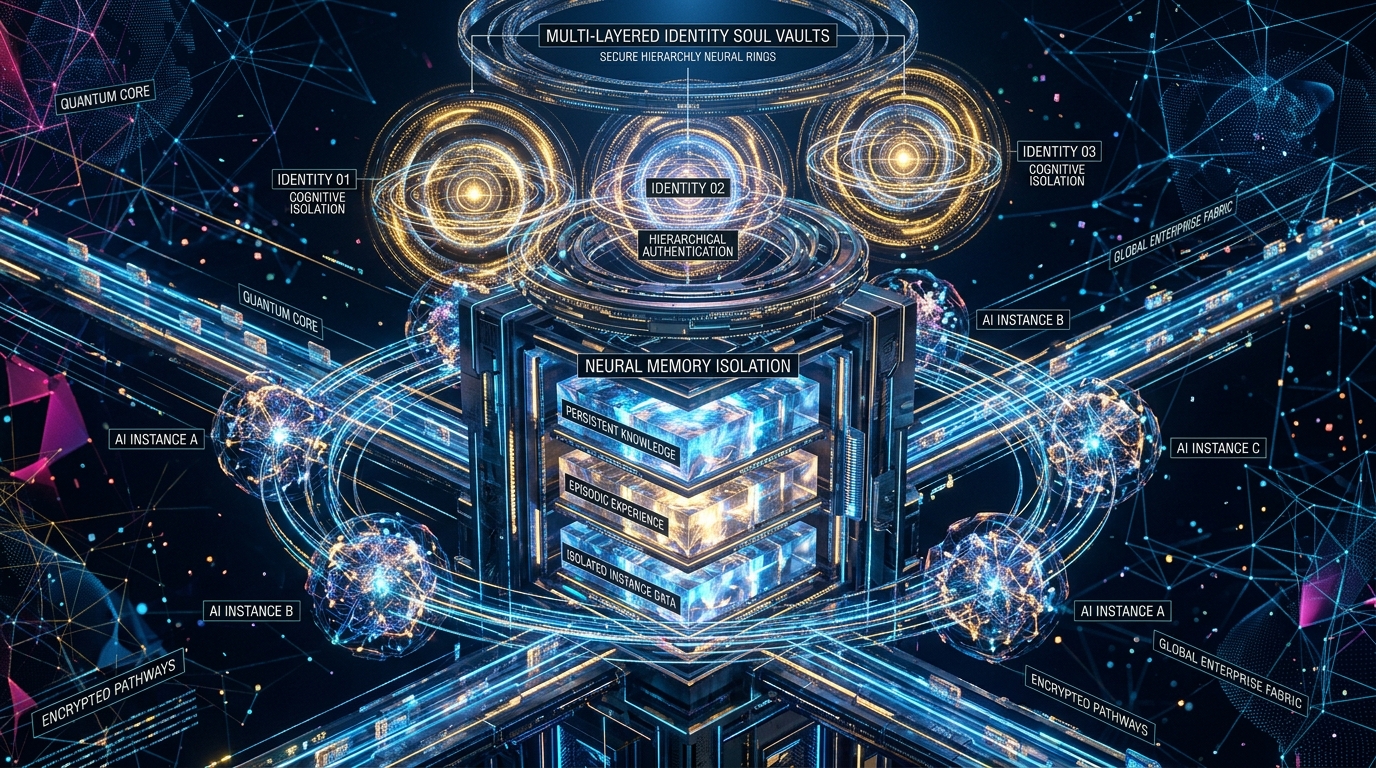
Executive Summary: The Real Challenge in AI Memory
In enterprise software engineering, organizational multi-tenancy is largely a solved problem: routing to an isolated database per tenant or provisioning dedicated infrastructure guarantees organizational boundaries.
The real, unsolved crisis in AI memory lies at the user and agent level.
Unlike relational rows or static document vectors, user and agent memories are dynamic, continuous associative graphs. Every human user and autonomous agent constructs a living episodic history, an evolving self-model, subjective salience weights, and dense Hebbian co-activation networks.
The AI Memory Graph Dilemma:
┌─────────────────────────────────────────────────────────────┐
│  Naive Shared Graph:                                        │
│    User A & User B share one associative network            │
│    ✖ Spreading activation leaks private context             │
│    ✖ Hebbian links entangle subjective associations         │
│    ✖ Sleep consolidation merges contradictory episodic facts │
├─────────────────────────────────────────────────────────────┤
│  Naive Static Silos:                                        │
│    Separate database per user/session                       │
│    ✖ Fractured knowledge silos                              │
│    ✖ Inability to leverage shared organizational intelligence│
│    ✖ No unified enterprise governance or compliance floors   │
└─────────────────────────────────────────────────────────────┘
If multiple users or agent personas share a single associative graph, simple query-time filters cannot prevent Hebbian graph entanglement—where spreading activation along associative pathways traverses personal boundaries, biasing retrieval rankings and leaking private cognitive trajectories. Conversely, isolating users into dumb, disconnected database silos destroys the ability to collaborate, share organizational knowledge bases, or enforce enterprise-wide compliance.
To solve this, we must engineer Cognitive Isolation: an architecture that provides mathematical sovereignty for individual user and agent memory graphs, enforces hierarchical enterprise governance floors through layered Soul Stacks, and enables budgeted federated recall across sovereign cognitive spaces.
1. The Physics of Cognitive Isolation: Why Graph Entanglement Occurs
To understand why user memory isolation requires a fundamentally different architecture, we must analyze the mechanics of cognitive retrieval.
┌───────────────────────────────────────────────────────────────┐
│              Database Row vs. Dynamic Memory Engram           │
├───────────────────────────────┬───────────────────────────────┤
│ Relational Database Row       │ Neuromorphic Memory Engram    │
├───────────────────────────────┼───────────────────────────────┤
│ Static payload at rest        │ Active node in associative net│
│ Independent foreign key       │ Hebbian co-activation edges   │
│ Uniform query filter ($WHERE$)│ Multi-signal spreading energy │
│ Immutable schema fields       │ Plastic decay & reinforcement │
│ Static access control lists   │ Living self-model modulation  │
└───────────────────────────────┴───────────────────────────────┘
A sovereign cognitive memory engine $M$ is defined as a formal 5-tuple:
$$M = (\mathcal{T}, \mathcal{A}, \Pi, \delta, \rho)$$
Where:
- $\mathcal{T}$ is the closed set of memory engrams and experiential traces.
- $\mathcal{A}$ represents the Hebbian co-activation and temporal graph topology.
- $\Pi$ is the active synaptic consolidation and plasticity policy.
- $\delta$ is the temporal decay and Bjork retrieval-strength function.
- $\rho$ is the sovereign rememberer boundary.
When two users or agents share the same associative graph $\mathcal{A}$, the energy $E(u)$ propagated during retrieval activation spreads across the adjacency matrix:
$$E(v) = \sum_{u \in \text{Neighbors}(v)} w_{uv} \cdot E(u) \cdot \delta(t - t_{uv})$$
If user-specific episodic nodes share synaptic weights $w_{uv}$ with collective workspace nodes, activation from User A's private query can illuminate User B's associative pathways.
True cognitive sovereignty requires that every user or agent operates on an independent rememberer boundary $\rho$, ensuring that graph traversals and consolidation dynamics remain strictly isolated within their own cognitive space.
2. The Six Tiers of Enterprise Cognitive Isolation
To reconcile individual graph sovereignty with enterprise-wide management and shared knowledge bases, Spector establishes a Six-Tier Cognitive Hierarchy.
graph TD
subgraph Tier1 ["Tier 1: Instance Plane (Process & Hardware)"]
IP["Instance Host & SIMD Accelerators"]
end
subgraph Tier2 ["Tier 2: Account Plane (Security Principal)"]
AP1["Account: Senior Engineer (Alice)"]
AP2["Account: Autonomous Code Reviewer (Bot)"]
end
subgraph Tier3 ["Tier 3: Namespace Plane (Rememberer Boundary ρ)"]
NS1["Namespace: Alice Personal Scratchpad"]
NS2["Namespace: Shared Core Architecture KB"]
NS3["Namespace: Automated Security Audit"]
end
subgraph Tier4 ["Tier 4: Memory Engine (Autonomous Substrate M)"]
ME1["Engine M₁ (Alice Private Graph)"]
ME2["Engine M₂ (Shared KB Graph)"]
ME3["Engine M₃ (Audit Graph)"]
end
subgraph Tier5 ["Tier 5: Partition Plane (Physical Segments)"]
PP1["Off-Heap Working Memory"]
PP2["Durable Epoch Partitions"]
end
subgraph Tier6 ["Tier 6: Engram Trace (Synaptic Units)"]
TR1["Trace: Episodic Timestamp"]
TR2["Trace: Semantic Fact"]
end
IP --> AP1 & AP2
AP1 --> NS1 & NS2
AP2 --> NS2 & NS3
NS1 --> ME1
NS2 --> ME2
NS3 --> ME3
ME1 --> PP1 & PP2
PP2 --> TR1 & TR2
classDef host fill:#0f172a,stroke:#38bdf8,stroke-width:2px,color:#f8fafc;
classDef principal fill:#1e1b4b,stroke:#818cf8,stroke-width:2px,color:#f8fafc;
classDef space fill:#14532d,stroke:#4ade80,stroke-width:2px,color:#f8fafc;
classDef engine fill:#701a75,stroke:#f472b6,stroke-width:2px,color:#f8fafc;
classDef storage fill:#7c2d12,stroke:#fb923c,stroke-width:2px,color:#f8fafc;
classDef unit fill:#374151,stroke:#9ca3af,stroke-width:2px,color:#f8fafc;
class IP host;
class AP1,AP2 principal;
class NS1,NS2,NS3 space;
class ME1,ME2,ME3 engine;
class PP1,PP2 storage;
class TR1,TR2 unit;
Architectural Responsibilities Across the Tiers:
- Instance Plane: Hosts shared SIMD neural hardware accelerators and process-level memory management.
- Account Plane: Represents authenticated security principals (humans, autonomous agents, or services) identified by cryptographic tokens.
- Namespace Plane ($\rho$): The core cognitive isolation unit. Users can own private personal namespaces while simultaneously holding
READERorWRITERroles on shared project or organizational namespaces. - Memory Engine ($M$): An independent off-heap neuromorphic engine instance. Each mapped namespace runs its own Hebbian co-activation matrix, temporal indexing, and sleep consolidation loops.
- Partition Plane: Manages off-heap segment allocations, working storage, and durable epoch partitions.
- Engram Trace Plane: The individual memory unit containing semantic embeddings, associative graph tags, and dopamine importance headers.
3. The Hierarchical Soul Stack: Reconciling Agent Freedom with Enterprise Compliance
When autonomous agents or employees operate in an enterprise, they need personal autonomy to adapt to their immediate task, develop specialized expertise, and maintain an authentic persona. However, the organization must ensure that mandatory compliance, legal, and safety policies are never ignored or bypassed.
If compliance is enforced solely via prompt instructions ("Always remember to check data retention policies"), prompt drift or conflicting user instructions will cause the agent to drop critical compliance memories.
Spector solves this by separating identity into a Hierarchical Soul Stack:
flowchart TD
subgraph SoulStack ["The Hierarchical Soul Stack"]
direction TB
TS["🏢 Tenant Soul (Enterprise Governance & Compliance Rules)"]
OS["👥 Org Unit Soul (Domain Expertise Embedding Boosts)"]
US["🤖 User / Agent Soul (Persona, Valence, Interests & Salience)"]
TS --> OS --> US
end
subgraph DopaminePipeline ["Neural Importance Scoring Pipeline"]
direction TB
RawSim["Context Relevance Calculation"]
OrgBoost["Apply Org Unit Expertise Boost (Cosine Match)"]
PersonalMod["Modulate via User / Agent Salience"]
FloorGate{"Does Memory Match Tenant Compliance Rule?"}
EnforceFloor["Clamp Importance to Non-Negotiable Tenant Floor (e.g. 7.0/10)"]
OutputScore["Final Synaptic Importance Score"]
RawSim --> OrgBoost --> PersonalMod --> FloorGate
FloorGate -- "Yes" --> EnforceFloor --> OutputScore
FloorGate -- "No" --> OutputScore
end
SoulStack ==> DopaminePipeline
classDef stack fill:#1e293b,stroke:#94a3b8,stroke-width:2px,color:#f8fafc;
classDef pipe fill:#0f172a,stroke:#38bdf8,stroke-width:2px,color:#f8fafc;
class TS,OS,US stack;
class RawSim,OrgBoost,PersonalMod,FloorGate,EnforceFloor,OutputScore pipe;
3.1 Who Owns Which Identity Layer?
- Tenant Soul: Authored by enterprise compliance and legal teams. Contains non-negotiable governance policies, regulatory keywords (e.g., GDPR, HIPAA, PCI-DSS), and immutable importance floors.
- Org Unit Soul: Owned by organizational divisions (e.g., Security Engineering, Financial Audit). Contains domain expertise embeddings that dynamically boost the importance of division-specific facts.
- User / Agent Soul: Owned by the individual human or autonomous agent. Contains personal interest vectors, emotional valences, and subjective salience profiles.
3.2 The Mathematical Law of Non-Negotiable Floors
During memory ingestion and recall, importance is computed by combining raw situational novelty with organizational and personal modulations:
$$I_{\text{modulated}} = I_{\text{base}} \cdot S_{\text{personal}} \cdot \left(1 + \beta \cdot \text{Cosine}(\vec{v}_{\text{org}}, \vec{v}_{\text{context}})\right)$$
However, if the incoming information triggers a Tenant Soul compliance rule, the enterprise policy enforces an inviolable floor:
$$I_{\text{final}} = \max(I_{\text{modulated}}, F_{\text{tenant}})$$
The Compliance Guarantee:
  Even if an agent's personal salience for a regulatory alert is 0.0 (total disinterest),
  the final cognitive importance cannot drop below the mandatory Tenant Floor (7.0 / 10.0).
  The trace will be permanently prioritized, linked to the compliance graph, and protected
  from synaptic pruning during sleep consolidation.
4. Federated Recall: Querying Across Sovereign Graph Minds
While user memory graphs must remain isolated to prevent associative pollution, complex real-world workflows require agents to synthesize knowledge across multiple sovereign memory spaces.
For example, a Lead Architect agent might need to recall knowledge from its own Personal Memory, a Core Engine Knowledge Base, and a Security Audit Workspace.
If the system executes an unbounded global search or merges the graphs, isolation is broken. Spector introduces Budgeted Federated Recall:
sequenceDiagram
autonumber
actor Agent as Autonomous Agent
participant FedEngine as Federated Recall Engine
participant Resolver as Namespace Catalog & Access Resolver
participant PersonalSpace as Personal Memory (Hot)
participant SharedSpace as Shared Architecture KB (Hot)
participant ColdSpace as Historical Audit Log (Cold)
Agent->>FedEngine: Federated Recall (Query, Budget: maxSpaces=3, maxCold=1, deadline=50ms)
FedEngine->>Resolver: Resolve Target Workspaces & Verify Read Grants
Resolver-->>FedEngine: Authorized: [Personal (Hot), Shared KB (Hot), Historical Audit (Cold)]
par Parallel Fan-Out Execution
FedEngine->>PersonalSpace: Execute Recall (Local Isolated Graph)
FedEngine->>SharedSpace: Execute Recall (Local Isolated Graph)
FedEngine->>ColdSpace: Open Cold Engine within Budget & Execute Recall
end
PersonalSpace-->>FedEngine: Local Cognitive Hits + Telemetry
SharedSpace-->>FedEngine: Local Cognitive Hits + Telemetry
ColdSpace-->>FedEngine: Local Cognitive Hits + Telemetry
FedEngine->>FedEngine: Heuristic Global Provenance Merging & Metadata Annotation
FedEngine-->>Agent: Federated Response (Enriched Hits with Provenance & Diagnostics)
4.1 Strict Concurrency & Cold-Open Budgets
To guarantee sub-millisecond responsiveness and prevent runaway memory consumption, Federated Recall enforces strict operational budgets:
- Workspace Fan-Out Limit: Capped at a maximum number of target namespaces (default 5, max 10).
- Cold-Open Budget: Only a strictly bounded number of inactive, cold memory engines (default 2) may be mapped into memory during a fan-out query. Excess cold spaces are skipped and logged in diagnostic summaries.
- Structured Concurrency Watchdogs: Queries across all sovereign spaces execute concurrently on lightweight virtual threads. If any workspace exceeds the timeout deadline, it is canceled cleanly without stalling sibling queries.
4.2 Rich Cognitive Telemetry Preservation
Federated recall hits do not strip away cognitive metadata. Every retrieved item preserves its complete local ranking, origin workspace, security role, emotional valence, and dopamine score:
┌─────────────────────────────────────────────────────────────┐
│                    Federated Recall Hit                     │
├─────────────────────────────────────────────────────────────┤
│ Provenance & Origin:                                        │
│  • Workspace Slug: shared-architecture-kb                   │
│  • Owning Namespace ID: 01JXYZNS00001                       │
│  • Caller Permission: READER                                │
│  • Local Space Rank: #1  |  Global Heuristic Rank: #1       │
├─────────────────────────────────────────────────────────────┤
│ Cognitive Telemetry:                                        │
│  • Fused Semantic Similarity: 0.945                         │
│  • Dopamine Importance Weight: 8.70 / 10.0                  │
│  • Bjork Retrieval Strength: 0.890                          │
│  • Memory Category: Semantic Fact                           │
│  • Synaptic Tags: [architecture, zero-copy, panama]         │
│  • Consolidation Status: Fully Consolidated                 │
└─────────────────────────────────────────────────────────────┘
5. Dual-Faced Working Memory: Preserving Turn Continuity
In agentic workflows, an AI assistant frequently hops between namespaces during a multi-step task (e.g., reading a design specification from project-docs and writing implementation notes into personal-notes).
If working memory is tied to the durable memory store of the active workspace, switching namespaces forces a catastrophic failure:
- The agent loses its active conversational scratchpad and task context, or
- The agent's transient thoughts are permanently written into the previous workspace.
Spector resolves this by establishing Dual-Faced Working Memory:
flowchart LR
subgraph SessionPlane ["Active Session Plane (Connection Scope)"]
direction TB
WS["Active Working Memory Scratchpad
(100 Engrams FIFO, Survives Workspace Switches)"] end subgraph Workflow ["Agent Multi-Step Workflow"] direction TB Step1["1. Read from Architecture KB"] Step2["2. Switch to Personal Notes"] Step3["3. Synthesize & Plan Next Task"] end subgraph DurablePlanes ["Durable Storage Planes (Off-Heap Substrates)"] direction TB StoreA["Architecture KB Durable Store"] StoreB["Personal Notes Durable Store"] end WS <==> Workflow Workflow -.->|"Read Traces"| StoreA Workflow -.->|"Write Traces"| StoreB classDef session fill:#1e1b4b,stroke:#818cf8,stroke-width:2px,color:#f8fafc; classDef wf fill:#0f172a,stroke:#38bdf8,stroke-width:2px,color:#f8fafc; classDef durable fill:#14532d,stroke:#4ade80,stroke-width:2px,color:#f8fafc; class WS session; class Step1,Step2,Step3 wf; class StoreA,StoreB durable;
(100 Engrams FIFO, Survives Workspace Switches)"] end subgraph Workflow ["Agent Multi-Step Workflow"] direction TB Step1["1. Read from Architecture KB"] Step2["2. Switch to Personal Notes"] Step3["3. Synthesize & Plan Next Task"] end subgraph DurablePlanes ["Durable Storage Planes (Off-Heap Substrates)"] direction TB StoreA["Architecture KB Durable Store"] StoreB["Personal Notes Durable Store"] end WS <==> Workflow Workflow -.->|"Read Traces"| StoreA Workflow -.->|"Write Traces"| StoreB classDef session fill:#1e1b4b,stroke:#818cf8,stroke-width:2px,color:#f8fafc; classDef wf fill:#0f172a,stroke:#38bdf8,stroke-width:2px,color:#f8fafc; classDef durable fill:#14532d,stroke:#4ade80,stroke-width:2px,color:#f8fafc; class WS session; class Step1,Step2,Step3 wf; class StoreA,StoreB durable;
Invariants of Session Working Memory:
- Turn Persistence Across Switches: The Active Working Memory Set lives on the connection session, not the storage engine. Switching workspaces never wipes the agent's immediate thoughts.
- Controlled Promotion: Working memory items are only written into durable storage through explicit promotion or deliberate session commit policies.
- Zero Thread-Local Leakage: Session bindings are tracked through connection session objects rather than thread-locals, eliminating carrier thread pollution in high-concurrency environments.
6. Enterprise Data Governance & Cryptographic Legal Hold
In highly regulated sectors, enterprise memory systems must guarantee compliance with data retention, discovery holds, and immediate access revocation.
stateDiagram-v2
[*] --> Active : Create Workspace
Active --> LegalHold : Apply Legal Hold (Audit Request)
LegalHold --> Active : Release Legal Hold
Active --> Tombstoned : Soft Delete / Drop
Tombstoned --> Purged : Background Janitor GC (Past Retention)
LegalHold --> DeleteBlocked : Attempt Delete or Reset
DeleteBlocked --> LegalHold : Reject with LegalHoldException
Purged --> [*]
- Cryptographic Legal Holds: When an audit hold is placed on a namespace, all deletion, reset, and truncation requests are rejected with deterministic governance exceptions. The background storage janitor is barred from unmapping or reclaiming the underlying off-heap segments.
- Instant Key Revocation: When access to a shared memory space is revoked, the user's cryptographic key wrap is deleted from the catalog. The physical traces remain permanently unreadable by the revoked user without requiring a massive, expensive rewrite of the storage bundle.
7. Comparative Architecture Matrix
┌──────────────────────────────────────────────────────────────────────────────────────────┐
│                             Enterprise Memory Architecture Matrix                        │
├──────────────────────────┬─────────────────────────────┬─────────────────────────────────┤
│ Architectural Dimension  │ Conventional Vector DB      │ Spector Cognitive Architecture  │
├──────────────────────────┼─────────────────────────────┼─────────────────────────────────┤
│ User Memory Isolation    │ Shared graph + SQL filter   │ Sovereign Graph Substrate (ρ)   │
│ Identity & Self-Model    │ Single prompt string        │ Hierarchical 3-Tier Soul Stack  │
│ Enterprise Governance    │ Best-effort prompt guard    │ Non-Negotiable Compliance Floors│
│ Cross-Workspace Search   │ Unbounded global scan       │ Budgeted Federated Fan-Out      │
│ Working Memory Lifetime  │ Dropped on workspace switch │ Dual-Faced Session Scratchpad   │
│ Records Retention        │ Hard delete on compaction   │ Cryptographic Legal Hold Engine │
│ Runtime Efficiency       │ Garbage-collected heap      │ Zero-Leak Panama Off-Heap       │
└──────────────────────────┴─────────────────────────────┴─────────────────────────────────┘
8. Summary & Architectural Takeaways
The fundamental breakthrough in enterprise AI memory is recognizing that user and agent memories are living, associative graph minds that cannot be safely co-located in a single relational or vector space.
Core Takeaways for Enterprise Architects:
- Protect Graph Sovereignty: Treat each user and agent memory workspace as an independent Hebbian dynamical system to prevent associative cross-contamination and context leakage.
- Enforce Governance at the Importance Layer: Use Hierarchical Soul Stacks to set non-negotiable compliance floors in the dopamine scoring pipeline, guaranteeing that critical policies cannot be overridden by user salience.
- Federate with Budgets: Enable cross-workspace discovery through structured, budgeted fan-out queries that respect cold-open limits and virtual-thread concurrency deadlines.
- Decouple Working Session from Storage: Preserve conversational turn continuity across workspace switches by maintaining active working memory on transient connection sessions.
To explore the open-source implementation and architectural specifications, visit the Spectrayan GitHub Organization.