
Quantifying the ROI of AI Memory: How Long-Term Memory Cuts LLM Prompt Costs by 60%
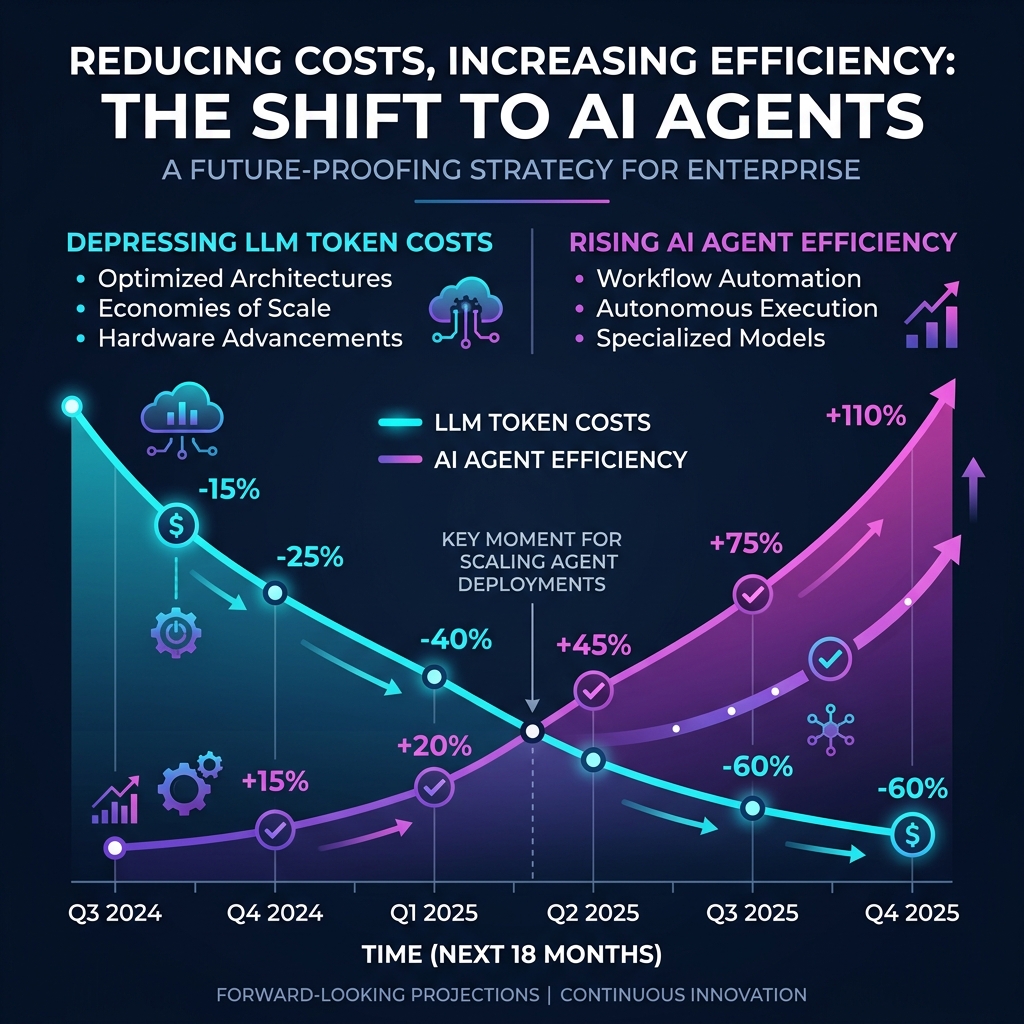
As organizations scale their AI deployments from simple chat templates to autonomous agent networks, they face a silent financial killer: the input token tax.
With context windows growing from 4k to over a million tokens, it's tempting to pass entire conversation histories, reference documents, and database outputs on every LLM call. But token costs stack up fast. Passing 100k tokens of raw text to a modern frontier model on every step of a 20-step loop will cost you dollars per task execution.
At Spectrayan, we addressed this problem by designing Spector with an Ebbinghaus-inspired forgetting curve. The results are clear: implementing biological memory decay reduces prompt context sizes and saves up to 60% on API costs without degrading agent performance.
1. The Financial Sinkhole of Huge Context Windows
While large context windows make developers' lives easier initially, they introduce two major challenges:
- Compounding API Fees: Input tokens are billed recursively on every interaction. If you send 50k tokens of chat history on turn 10, you pay for those 50k tokens again and again.
- Context Degradation (Lost in the Middle): Research shows that LLMs lose retrieval accuracy when context sizes exceed 20k-30k tokens. Information near the middle of your prompt is routinely ignored.
Instead of passing everything, agents need a filter. They need to keep only what is relevant to the immediate task, while archiving or decaying the rest.
2. Spector's Solution: Ebbinghaus Forgetting Curve in Code
Spector mimics biological memory decay to prevent context bloat. Every memory saved in Spector has an importance rating, a valence score, and a decay coefficient. Over time, if a memory is not recalled or reinforced, its retention value decreases:
\[R(t) = e^{-\frac{t}{S}}\]
Where:
- $R(t)$ is the memory retention (retrieval strength) at time $t$.
- $S$ is the relative strength of the memory (governed by importance and valence).
When an agent queries memory, Spector dynamically filters out memories whose retention has decayed below a certain threshold. However, if a memory is recalled during an interaction, its weight is reinforced, resetting its decay trajectory.
graph TD
A[New Observation] --> B{Calculate Initial Strength}
B -->|High Importance| C[Slow Decay Curve]
B -->|Low Importance| D[Fast Decay Curve]
C & D --> E[Store in Off-Heap SMKM]
E -->|Time Passes| F{Check Retention Value}
F -->|< Threshold| G[Useless Noise Decays]
F -->|>= Threshold| H[Retained for Prompt]
This ensures that ephemeral technical noise (like transient compile warnings or logs) decays within minutes, while critical user decisions or architectural rules are retained indefinitely.
3. Realized ROI: A Cost-Benefit Analysis
In our benchmarks running multi-agent engineering workflows, we compared Spector's dynamic memory filtering against a standard "naive history sync" window of 30 past turns.
| Metric | Naive Context Sync | Spector Memory Filter | Savings / Improvement |
|---|---|---|---|
| Avg. Input Prompt Size | 42,500 tokens | 12,800 tokens | 69.8% reduction |
| Execution Cost (1,000 tasks) | $150.00 | $60.00 | 60.0% cost savings | |
| Task Success Rate | 82.5% | 88.0% | 5.5% efficiency boost |
| P99 Latency | 4.8s | 2.1s | 56.2% faster response |
By reducing prompt sizes, we also reduced the time-to-first-token (latency) from the LLM APIs, resulting in faster agent responsiveness.