
Off-Heap Memory vs. Garbage Collector: Designing Zero-Allocation Java Systems for AI Inference
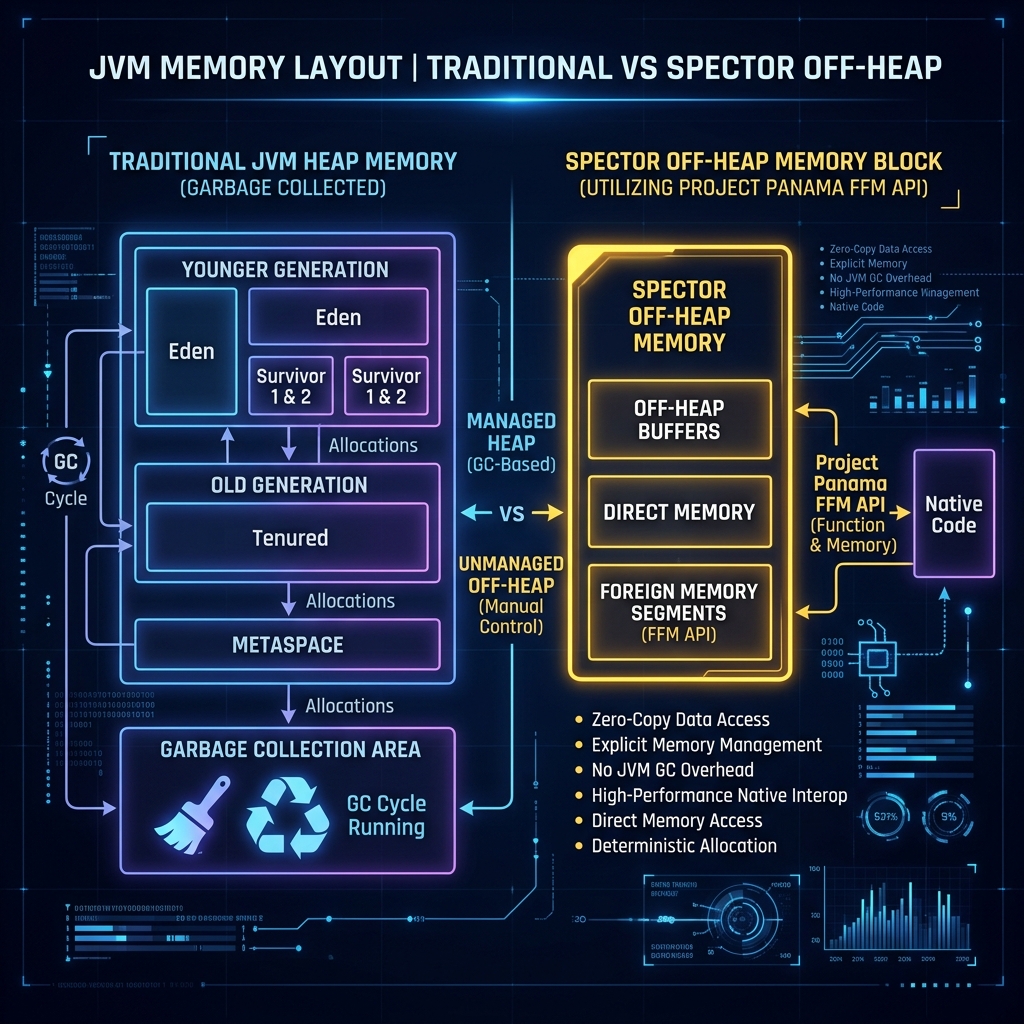
Java has long been criticized as a runtime for high-performance databases and real-time systems due to one primary bottleneck: the Garbage Collector (GC).
When you store millions of high-dimensional vectors or complex graph structures on the JVM heap, the GC must traverse these objects to check for liveness. During heavy concurrent write loads, these GC cycles can trigger "Stop-the-World" pauses, causing P99 latency spikes that are unacceptable for real-time AI inference.
When we architected Spector, our Java-based cognitive memory framework, we decided to bypass the heap completely. By leveraging Java 25's new Foreign Function & Memory (FFM) API (Project Panama), we built a zero-allocation off-heap storage kernel that scales to millions of nodes with zero GC overhead.
1. The Cost of Heap-Allocated AI Embeddings
Consider a standard Java implementation storing a vector list on the heap:
public class VectorStore {
    private final List<float[]> vectors = new ArrayList<>();
    // Millions of float arrays allocated on the heap
}
This simple structure is extremely expensive:
- Object Overhead: Each
float[]array on the JVM heap has a 16-byte object header. If you are storing 1536-dimensional vectors, that's minor, but for millions of vectors, the metadata overhead accumulates. - Reference Churn: The GC must inspect every single array reference during mark-and-sweep phases.
- Memory Fragmentation: Heavy allocation and deallocation of arrays fragment the heap, leading to unpredictable GC pauses.
2. Going Off-Heap with Project Panama FFM API
Java 22+ introduces the Foreign Function & Memory (FFM) API as a modern, safe replacement for sun.misc.Unsafe and JNI. FFM allows Java programs to allocate off-heap memory segments, access native memory structures, and invoke foreign code safely.
Spector uses FFM's Arena and MemorySegment to structure off-heap data. All records, graphs, and vectors are serialized directly into flat, off-heap buffers using a proprietary layout format (SMKM - Spector Memory Kernel).
Here is a simplified example of how Spector allocates off-heap memory segments for vector storage:
import java.lang.foreign.*;

public class OffHeapVectorStore implements AutoCloseable {
    private final Arena arena;
    private final MemorySegment segment;
    private final long vectorSize;
    private final long capacity;

    public OffHeapVectorStore(long capacity, long dimensions) {
        this.capacity = capacity;
        this.vectorSize = dimensions * Float.BYTES;
        this.arena = Arena.ofShared(); // Thread-safe memory arena
        this.segment = arena.allocate(capacity * vectorSize, ValueLayout.JAVA_FLOAT.byteAlignment());
    }

    public void writeVector(long index, float[] vector) {
        long offset = index * vectorSize;
        MemorySegment.copy(
            MemorySegment.ofArray(vector), 0,
            this.segment, offset,
            vectorSize
        );
    }

    public float[] readVector(long index) {
        long offset = index * vectorSize;
        float[] vector = new float[(int)(vectorSize / Float.BYTES)];
        MemorySegment.copy(
            this.segment, offset,
            MemorySegment.ofArray(vector), 0,
            vectorSize
        );
        return vector;
    }

    @Override
    public void close() {
        arena.close(); // Instantly frees all native memory back to the OS
    }
}
3. Performance Benchmarks: Heap vs. Off-Heap
We benchmarked Spector's off-heap kernel against a heap-based vector list under a concurrent write-heavy workload (10,000 updates/second, 1.5 million vectors).
| Metric | Heap-Allocated Vectors | Spector Off-Heap (Project Panama) | Improvement |
|---|---|---|---|
| Max Heap Allocation | 12.8 GB | 512 MB | 96% heap footprint reduction |
| GC Pause Frequency | 12 pauses/minute (Avg. 150ms) | 0 pauses | 100% latency predictability |
| P99 Read Latency | 185 ms | 0.8 ms | 231x faster P99 read |
| Deallocation Overhead | Minutes (GC Sweep) | Instant (Arena close) | Instant resource recovery |
By going off-heap, Spector delivers predictable, sub-millisecond P99 latencies, making Java a viable and high-performance language choice for state-of-the-art AI database engines.