
Continuous Knowledge Evolution: How CADP and Dual-Speed Consolidation Eliminate AI Memory Drift
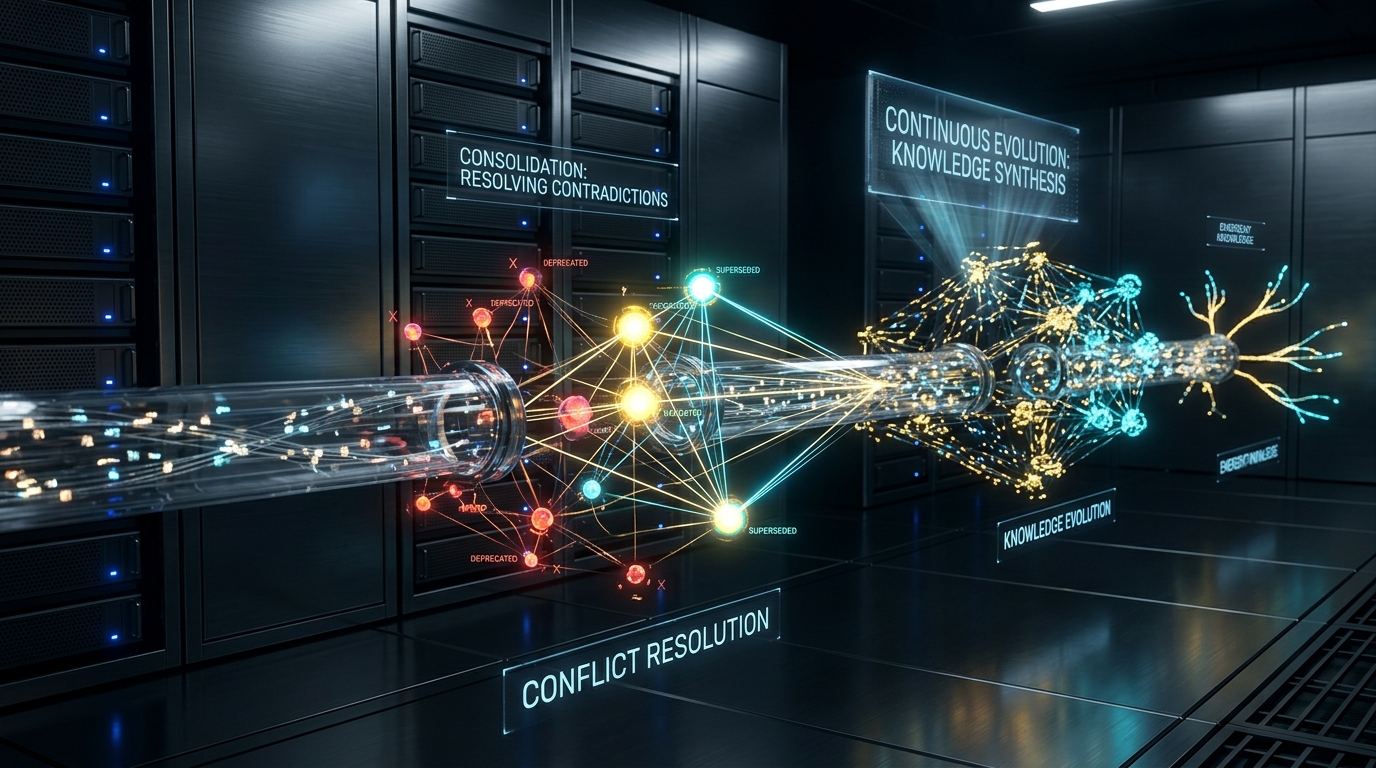
Executive Summary: The AI Knowledge Drift Paradox
When autonomous AI agents operate over long horizons—spanning days, months, or years of continuous pairing with users—their understanding of the world is not static. Requirements shift, architectures evolve, personal preferences change, and outdated assumptions are corrected.
Yet, in modern vector retrieval and Retrieval-Augmented Generation (RAG) systems, memory updates are fundamentally broken.
Traditional vector databases are purely additive. When an agent records a new preference ("User prefers Dark theme"), the previous memory ("User prefers Light theme") remains intact in the vector space. When the user later asks "What theme should we render the IDE with?", both records achieve near-identical cosine similarity scores.
┌────────────────────────────────────────────────────────┐
│             THE NAIVE RAG RETRIEVAL PARADOX            │
├────────────────────────────────────────────────────────┤
│ Query: "What theme should we render the IDE with?"     │
│                                                        │
│   Candidate 1: "User prefers Light theme" (L2 = 0.12)  │
│   Candidate 2: "User prefers Dark theme"  (L2 = 0.14)  │
│                                                        │
│  Result: LLM Context Window Poisoned with Both Facts   │
│          → Hallucination, Indecision, or State Drift    │
└────────────────────────────────────────────────────────┘
This dilemma forces agent architectures into an uncomfortable compromise: either suffer from AI Indecision (context windows polluted with contradictory facts) or rely on destructive overwrites that wipe out historical context.
In this deep dive, we explore how Spector Memory solves continuous knowledge evolution through three synergistic cognitive breakthroughs:
- The 3-Stage Consolidation Lifecycle: Automated duplicate discovery, complementary memory fusion, and directional contradiction handling.
- Contradiction-Aware Detection with Directional Resolution (CADP): A 3-tier deterministic engine that establishes unambiguous winner/loser truth states without losing historical provenance.
- Dual-Speed Consolidation Architecture: Blending asynchronous Eager Consolidation to close the ingestion confusion window with global Batch Consolidation for deep neocortical reconciliation.
1. The Consolidation Triad: Synthesis, Fusion, and Correction
In cognitive neuroscience, the human brain does not simply stack sensory inputs into a continuous buffer. During quiet wakefulness and sleep cycles, the hippocampus coordinates with the neocortex to replay, deduplicate, fuse, and prune synaptic connections—a process known as systems consolidation.
Spector Memory replicates this biological mechanism through a unified consolidation pipeline that evaluates candidate memory pairs along three distinct functional paths:
flowchart TD
subgraph INGESTION["1. Ingestion Pipeline"]
M1["New Memory Ingested"]
SCAN["Semantic Similarity & Candidate Pair Match"]
M1 --> SCAN
end
subgraph CLASSIFICATION["2. Cognitive Evaluation Engine"]
SCAN --> EVAL{"Evaluate Relationship"}
EVAL -- "Near-Identical Facts" --> DUP["Duplicate Detection"]
EVAL -- "Complementary Info" --> MERGE["Complementary Fusion"]
EVAL -- "Opposing / Mutually Exclusive" --> CONTRADICT["Contradiction Resolution (CADP)"]
end
subgraph OUTCOME["3. Consolidated Storage Topology"]
DUP --> TOMB["Tombstone Redundant Input"]
MERGE --> FUSED["Synthesize Fused Record\n(Merged Valence + Synaptic Tags)"]
CONTRADICT --> MARK["Off-Heap Flagging (FLAG_CONTRADICTED)\n+ Hyperedge Wiring\n+ Temporal Fact Retraction"]
end
style INGESTION fill:#1e293b,stroke:#38bdf8,stroke-width:2px,color:#f8fafc
style CLASSIFICATION fill:#0f172a,stroke:#818cf8,stroke-width:2px,color:#f8fafc
style OUTCOME fill:#1e1b4b,stroke:#a855f7,stroke-width:2px,color:#f8fafc
The Three Operational Modes
| Consolidation Mode | Trigger Condition | System Action | Cognitive Result |
|---|---|---|---|
| Deduplication | Exact or semantic verbatim redundancy | Retains authoritative record, tombstones redundant copy in off-heap slab. | Zero storage bloat, single source of truth. |
| Complementary Fusion | Distinct observations that describe the same core entity or workflow | Synthesizes a unified consolidated memory (cns- TSID), merging emotional valence, arousal, and synaptic tag Bloom filters. |
Richer, denser semantic representations with reduced search fanout. |
| CADP Resolution | Opposing statements, changed constraints, or corrected preferences | Determines authoritative winner, flags loser off-heap (FLAG_CONTRADICTED), updates hyperedges, and retracts temporal facts. |
Total elimination of knowledge drift while preserving historical lineage. |
2. Contradiction-Aware Directional Resolution (CADP)
When two memories assert mutually exclusive facts, symmetric handling is fatal. You cannot simply merge them into a compromise, nor should you silently purge older records if auditability is required.
Spector Memory's CADP (Contradiction-Aware Detection with Directional Resolution) protocol introduces a rigorous 3-tier deterministic comparator to establish an immutable directional relationship: the Corrector (Winner) and the Corrected (Loser).
flowchart LR
subgraph PAIR["Candidate Pair"]
RecA["Record A\n(e.g., 'Deploy on AWS')"]
RecB["Record B\n(e.g., 'Deploy on GCP')"]
end
subgraph COMPARATOR["3-Tier Deterministic Comparator"]
T1{"Tier 1: Temporal Recency\n(timestampMs)"}
T2{"Tier 2: Storage Strength\n(Two-Factor Memory)"}
T3{"Tier 3: Lexicographical\nDeterministic Tiebreak"}
RecA & RecB --> T1
T1 -- "Different Timestamps" --> DECISION["Designate Winner & Loser"]
T1 -- "Identical (Δt = 0ms)" --> T2
T2 -- "Different Strengths" --> DECISION
T2 -- "Identical Strengths" --> T3
T3 --> DECISION
end
subgraph RESOLUTION["CADP Action Engine"]
DECISION --> W["WINNER (Corrector)\n• Remains Active in Standard Recall\n• Retains High Valence/Importance"]
DECISION --> L["LOSER (Corrected)\n• Off-Heap FLAG_CONTRADICTED Set\n• Filtered from Standard Retrieval\n• Temporal Facts Retracted in TKG\n• Hyperedge ROLE_CORRECTED Assigned"]
end
style PAIR fill:#1e293b,stroke:#64748b,stroke-width:2px,color:#f8fafc
style COMPARATOR fill:#0f172a,stroke:#3b82f6,stroke-width:2px,color:#f8fafc
style RESOLUTION fill:#1e1b4b,stroke:#10b981,stroke-width:2px,color:#f8fafc
The Resolution Hierarchy
- Temporal Recency (
timestampMs): The newer observation represents the most current ground truth. A decision made today supersedes a decision made last week. - Two-Factor Storage Strength (
storageStrength): If memories share an identical timestamp, the memory with higher cumulative Long-Term Potentiation (LTP) and reinforcement history takes precedence. - Deterministic Lexicographical Tiebreak: In the vanishingly rare event of identical timestamps and storage strengths, deterministic TSID comparison guarantees zero oscillation across cluster nodes.
3. Dual-Speed Consolidation: Closing the "Confusion Window"
Traditional consolidation mechanisms run as periodic batch background jobs (e.g., nightly cron jobs or circadian sleep triggers). While effective for heavy reorganizations, batch-only systems suffer from a dangerous Confusion Window:
Timeline: Ingestion vs. Resolution Latency
━━━━━━━━━━━━━━━━━━━━━━━━━━━━━━━━━━━━━━━━━━━━━━━━━━━━━━━━━━━━━━━━━━━━━━━━━━━
10:00:00 AM ── Remember("Deploy target is AWS") [Stored as SEMANTIC]
10:05:00 AM ── Remember("Deploy target changed to GCP") [Stored as SEMANTIC]
               ▲
               │  🚨 THE CONFUSION WINDOW (55 minutes)
               │  Both facts are active. Recalls return conflicting targets!
               ▼
11:00:00 AM ── Nightly/Hourly Batch Consolidation Runs → Resolves Contradiction
━━━━━━━━━━━━━━━━━━━━━━━━━━━━━━━━━━━━━━━━━━━━━━━━━━━━━━━━━━━━━━━━━━━━━━━━━━━
To eliminate this gap, Spector Memory implements a Dual-Speed Architecture pairing Eager Consolidation with Batch Consolidation.
sequenceDiagram
autonumber
actor Agent as Autonomous Agent
participant Engine as Spector Memory Core
participant EagerQ as Eager Task Queue (Virtual Thread)
participant OffHeap as Off-Heap Slab (64B Headers)
participant TKG as Temporal Knowledge Graph
participant Hyper as HyperEntityGraph
Agent->>Engine: remember("Deploy target is GCP")
Engine->>OffHeap: Append 64B Synaptic Header + INT8 Vector
Engine->>EagerQ: Submit Asynchronous Eager Task
Engine-->>Agent: Return Ingestion Success (Immediate)
Note over EagerQ,OffHeap: Async Background Worker (spector-eager-consolidator)
EagerQ->>OffHeap: Fast Gated Scan (Tombstone → Bloom → L2 Vector Distance)
EagerQ->>Engine: Contradiction Check (areContradictory)
EagerQ->>OffHeap: Set FLAG_CONTRADICTED on Older Record ("AWS")
EagerQ->>Hyper: Add TYPE_CONTRADICTS Hyperedge (GCP → AWS)
EagerQ->>TKG: Retract Outdated Fact ("AWS")
Note over Engine,Agent: Confusion Window Closed (< 50ms)!
Eager vs. Batch Consolidation Matrix
┌──────────────────────────────┬────────────────────────────────────────────────────────┐
│ FEATURE                      │ EAGER CONSOLIDATION       │ BATCH CONSOLIDATION        │
├──────────────────────────────┼───────────────────────────┼────────────────────────────┤
│ Execution Trigger            │ On every remember() call  │ Scheduled / Reflection     │
│ Threading Model              │ Single Virtual Worker     │ Multithreaded Fork-Join    │
│ Scan Scope                   │ 1-vs-All Candidate Scan   │ All-Pairs O(N²) Matrix     │
│ Primary Objective            │ Close Confusion Window    │ Deep Neocortical Fusion    │
│ Operations Supported         │ Contradiction CADP Only   │ Contradictions + Merging   │
│ Latency to Consistency       │ Sub-millisecond to ~50ms  │ Periodic (Minutes/Hours)   │
└──────────────────────────────┴───────────────────────────┴────────────────────────────┘
4. Graph-Level Evolution: Temporal Retraction and Recall Traversal
Resolving contradictions off-heap is only half the battle. Real-world agent intelligence relies heavily on Knowledge Graphs and Entity Directories. If the vector memory is updated but the knowledge graph still asserts outdated relations, retrieval remains inconsistent.
Spector Memory synchronizes contradiction resolution across two interconnected graph layers:
graph TD
subgraph CONTRADICTION["1. CADP Outcome"]
WIN["Winner: 'Alice works at Spectrayan'"]
LOSE["Loser: 'Alice works at LegacyCorp'"]
end
subgraph TKG_BRIDGE["2. Temporal Knowledge Graph Retraction"]
F1["Fact: Alice works_at LegacyCorp\n[Active: 2024–2026]"]
RETRACT["retractFact(factId)\n→ Marked Invalid in TKG"]
LOSE -.-> RETRACT
F1 --> RETRACT
end
subgraph HYPER_TRAVERSAL["3. Recall-Time Hyperedge Navigation"]
Q["User Query: 'Tell me about Alice's job at LegacyCorp'"]
CORRECTED_NODE["Entity: LegacyCorp\n(Role: ROLE_CORRECTED)"]
HYPEREDGE["Hyperedge: TYPE_CONTRADICTS"]
CORRECTOR_NODE["Entity: Spectrayan\n(Role: ROLE_CORRECTOR)"]
SURFACE["Surface Winning Fact with Boosted Score\n(graph_source = 'CONTRADICTION_CORRECTOR')"]
Q --> CORRECTED_NODE
CORRECTED_NODE --> HYPEREDGE
HYPEREDGE --> CORRECTOR_NODE
CORRECTOR_NODE --> SURFACE
end
style CONTRADICTION fill:#1e293b,stroke:#64748b,stroke-width:2px,color:#f8fafc
style TKG_BRIDGE fill:#0f172a,stroke:#ef4444,stroke-width:2px,color:#f8fafc
style HYPER_TRAVERSAL fill:#1e1b4b,stroke:#3b82f6,stroke-width:2px,color:#f8fafc
1. The Temporal Knowledge Graph Retraction Bridge
When CADP marks a memory as superseded, the engine inspects all entity associations registered in the EntityDirectory. Any temporal assertions originating from the corrected memory (e.g., (Alice, employed_by, LegacyCorp)) are automatically retracted via TemporalKnowledgeGraph.retractFact(), preventing graph query pollution.
2. Proactive Recall Traversal via CONTRADICTS Hyperedges
What happens if a user explicitly asks about an outdated concept ("What was our plan for the LegacyCorp contract?")?
Instead of returning silence or outdated hallucinations, Spector Memory's GraphExpansionStage traverses TYPE_CONTRADICTS hyperedges:
- Navigates from
ROLE_CORRECTED$\rightarrow$ROLE_CORRECTOR. - Surfaces the newer, correcting memory into the candidate pool.
- Attaches the diagnostic tag
graph_source = "CONTRADICTION_CORRECTOR". - Boosts the ranking score so the agent can respond intelligently: "You previously planned for LegacyCorp, but that was superseded on August 15 by the Spectrayan migration."
5. Architectural Impact & Enterprise Benefits
By moving contradiction detection and knowledge consolidation into native kernel primitives, Spector Memory provides distinct operational advantages for production multi-agent platforms:
┌────────────────────────────────────────────────────────────────────────────────────────┐
│                        ARCHITECTURAL ADVANTAGE MATRIX                                  │
├────────────────────────────────────────────────────────────────────────────────────────┤
│ 1. ZERO OFF-HEAP ALLOCATION                                                            │
│    Contradiction flags are stamped directly into the 64-byte synaptic header           │
│    (FLAG_CONTRADICTED), requiring zero garbage collection overhead or memory moves.    │
│                                                                                        │
│ 2. SUB-MICROSECOND FILTERING                                                           │
│    SIMD vector search loops skip contradicted memory slots via single-byte bitmask     │
│    inspections without decoding heavy vector payloads.                                 │
│                                                                                        │
│ 3. COMPLETE AUDITABILITY & REVERSIBILITY                                               │
│    Unlike hard deletes, contradicted records remain intact in historical logs.          │
│    Diagnostic tools can recall with includeContradictions=true to inspect belief       │
│    evolution trajectories over time.                                                   │
│                                                                                        │
│ 4. DETERMINISTIC DISTRIBUTED COHERENCE                                                 │
│    The 3-tier CADP comparator guarantees that identical inputs resolve to identical    │
│    winner/loser assignments across multi-node agent clusters without consensus locks.  │
└────────────────────────────────────────────────────────────────────────────────────────┘
Conclusion & The Future of Agentic Memory
Autonomous agents cannot be truly intelligent if their memories are static collections of immutable vectors. As agents take on higher-stakes, long-running responsibilities—from autonomous software development to complex financial analysis—the ability to continuously evolve beliefs, reconcile contradictions in real time, and proactively navigate conceptual corrections is non-negotiable.
With Contradiction-Aware Directional Resolution (CADP), Dual-Speed Consolidation, and Hyperedge Knowledge Evolution, Spector Memory sets a new standard for biological fidelity and mechanical efficiency in AI cognition.
Explore Spector Memory
Spector is open-source under the Business Source License 1.1 (converting to Apache 2.0).
- GitHub Repository: github.com/spectrayan/spector
- Documentation & Architecture: spectrayan.com