
Adaptive Softmax Retrieval Temperature: How Prediction Error and Dopamine Z-Scores Dynamically Scale AI Memory Breadth
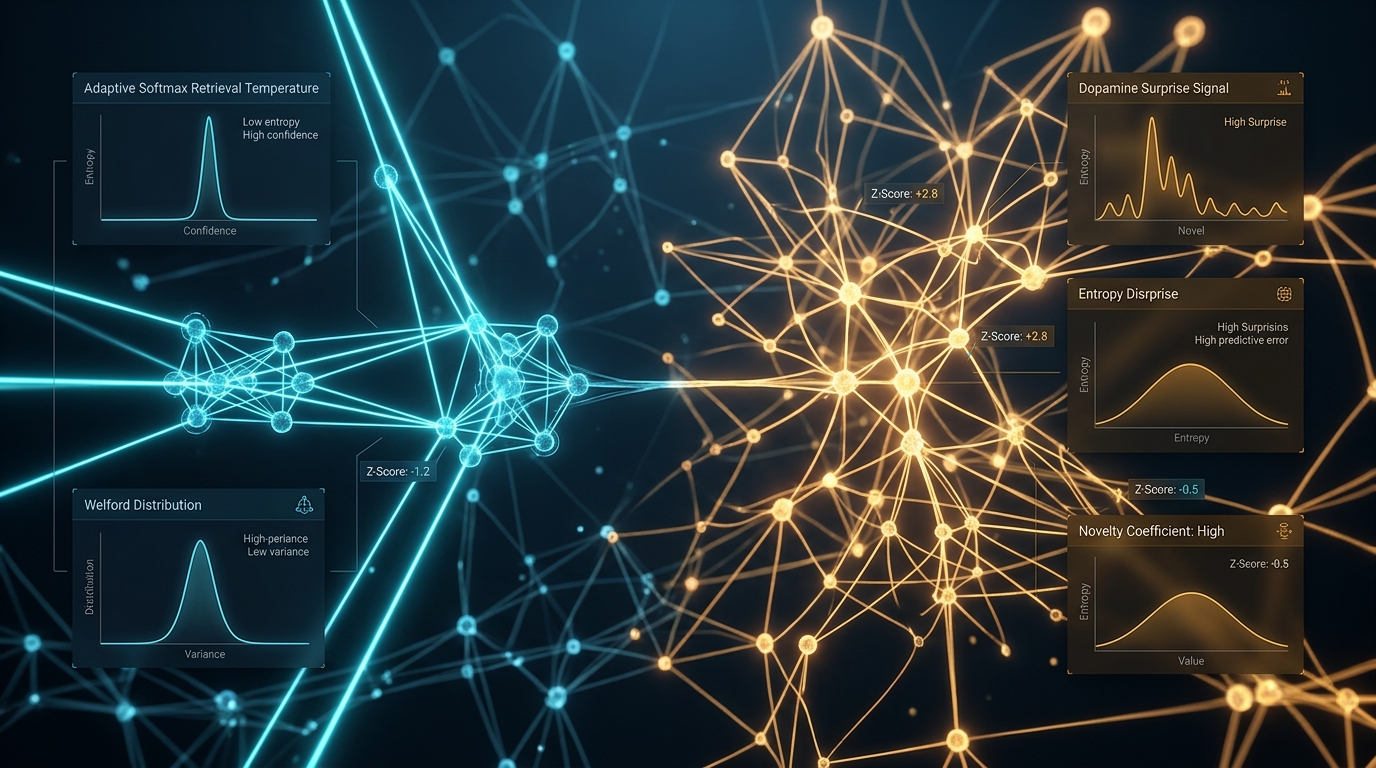
Executive Summary: The Rigid Top-K Retrieval Paradox
Traditional vector search and Retrieval-Augmented Generation (RAG) engines operate under a static, one-size-fits-all paradigm: for any incoming query vector, retrieve the top $K$ nearest neighbors above a fixed cosine or Euclidean distance threshold.
While this deterministic approach works for repetitive, in-distribution lookups, it creates a fatal dilemma for autonomous AI agents facing dynamic, real-world workloads:
┌─────────────────────────────────────────────────────────────┐
│             THE STATIC VECTOR RETRIEVAL PARADOX             │
├─────────────────────────────────────────────────────────────┤
│ 1. ROUTINE / FAMILIAR QUERY                                 │
│    Query: "What is our company's primary database port?"    │
│    Problem: Top-K pulls in 10 tangentially related memories │
│    Result: Irrelevant context noise, prompt bloat, latency  │
│                                                             │
│ 2. NOVEL / EXPLORATORY QUERY (OUT-OF-DISTRIBUTION)         │
│    Query: "We hit an unprecedented corrupted page in cluster│
│           node 4 after a kernel panic—what could connect?"  │
│    Problem: High distance causes strict filters to drop all  │
│             associative, lateral, or analogical clues       │
│    Result: Empty context, false negative, or hallucination  │
└─────────────────────────────────────────────────────────────┘
In biological cognition, the brain does not use a fixed top-$K$ filter. When confronted with familiar stimuli, the prefrontal cortex sharpens attention to a tight, high-confidence memory trace. But when confronted with novelty or unexpected prediction errors (a burst of dopaminergic surprise), neuromodulators instantly broaden synaptic excitability—allowing distant, lateral associations to compete and surface.
In this deep dive, we explore how Spector Memory brings biological surprise to agentic retrieval through Adaptive Softmax Retrieval Temperature, establishing a dynamic bridge between online Welford statistics, prediction error z-scores, and information-theoretic retrieval entropy.
1. The Neurobiological Foundation: Prediction Error as an Attention Modulator
In neuroscience, dopamine is not merely a reward chemical—it is the brain's primary currency for temporal difference prediction error (TD-PE). When sensory inputs match internal cognitive models, dopamine firing remains at baseline. When inputs deviate significantly from expectation, a dopamine burst signals the hippocampus and neocortex to expand the search radius for associative memories.
flowchart TD
subgraph STIMULUS["1. Query Input Stream"]
Q["Incoming Agent Query Vector\nq ∈ R^d"]
CENTROID["Nearest Partition Centroid / Cluster"]
Q --> CENTROID
end
subgraph PREDICTION_ERROR["2. Dopaminergic Surprise Estimation"]
CENTROID --> DIST["Compute L2 Distance (d_min)"]
DIST --> WELFORD["Online Welford Statistics\n(Running Mean μ & Variance σ^2)"]
WELFORD --> ZSCORE["Calculate Surprise Z-Score\nz = (d_min - μ) / σ"]
end
subgraph TEMPERATURE_DYNAMICS["3. Dynamic Entropy Modulation"]
ZSCORE --> EVAL{"Surprise Evaluation"}
EVAL -- "z <= 0 (Familiar / Expected)" --> EXPLOIT["Low Temperature (T <= 1.0)\n• High Distribution Sharpness\n• Suppress Marginal Candidates\n• Focused Precision (Exploitation)"]
EVAL -- "z > 0 (Novel / Unexpected)" --> EXPLORE["High Temperature (T > 1.0)\n• Flatten Score Distribution\n• Boost Distant Lateral Candidates\n• Broad Discovery (Exploration)"]
end
style STIMULUS fill:#1e293b,stroke:#38bdf8,stroke-width:2px,color:#f8fafc
style PREDICTION_ERROR fill:#0f172a,stroke:#eab308,stroke-width:2px,color:#f8fafc
style TEMPERATURE_DYNAMICS fill:#1e1b4b,stroke:#a855f7,stroke-width:2px,color:#f8fafc
By coupling retrieval temperature directly to online prediction error, Spector Memory allows the agent to self-tune its retrieval aperture on every single query without human heuristics or rigid per-query configurations.
2. The Mathematical Engine: Non-Mutating Welford Z-Scores & Dynamic Scaling
To modulate temperature reliably without corrupting ongoing learning statistics, Spector Memory divides the process into two decoupled steps:
A. Non-Mutating Query Surprise Peek
During standard ingestion, the SurpriseDetector maintains running distance statistics using Welford's algorithm for numerically stable online mean ($\mu$) and variance ($M_2$).
During a recall query, however, updating the distribution would falsely register retrieval probes as permanent memories. Spector Memory implements a pure read-only peek:
$$z_{\text{surprise}} = \frac{d_{\text{min}} - \mu}{\sqrt{M_2 / (N - 1)}}$$
Where $d_{\text{min}}$ is the Euclidean distance from the query vector to the nearest active partition centroid. If the system is still in its warmup phase ($N < 20$), the detector returns a neutral $z = 0.0$ to guarantee baseline deterministic recall.
sequenceDiagram
autonumber
participant Agent as Autonomous Agent
participant Pipeline as RecallPipeline
participant Router as PartitionRouter
participant Dopamine as SurpriseDetector
participant Softmax as TemperatureSoftmax
Agent->>Pipeline: recall(queryVector, options)
Pipeline->>Router: nearestDistance(queryVector)
Router-->>Pipeline: d_min = 1.84f
Pipeline->>Dopamine: querySurpriseZScore(d_min)
Note over Dopamine: Read-Only Peek
Does NOT increment N or M2 Dopamine-->>Pipeline: z_surprise = +2.40 (Novel Stimulus) Pipeline->>Pipeline: computeEffectiveTemperature(z_surprise) Note over Pipeline: T = clamp(1.0 * (1 + 0.15 * 2.40)) = 1.36f Pipeline->>Softmax: applySoftmaxTemperature(candidates, 1.36f) Softmax-->>Pipeline: Entropy-Modulated Candidate Scores Pipeline-->>Agent: Top-K Associative Results
Does NOT increment N or M2 Dopamine-->>Pipeline: z_surprise = +2.40 (Novel Stimulus) Pipeline->>Pipeline: computeEffectiveTemperature(z_surprise) Note over Pipeline: T = clamp(1.0 * (1 + 0.15 * 2.40)) = 1.36f Pipeline->>Softmax: applySoftmaxTemperature(candidates, 1.36f) Softmax-->>Pipeline: Entropy-Modulated Candidate Scores Pipeline-->>Agent: Top-K Associative Results
B. The Adaptive Scaling Law
The effective temperature $T$ is computed via a monotonic scaling law with lower and upper safety bounds:
$$T = \operatorname{clamp}\left(T_{\text{base}} \times \left(1 + \kappa \times \max(0, z_{\text{surprise}})\right), T_{\text{min}}, T_{\text{max}}\right)$$
- $T_{\text{base}}$ ($1.0$): Baseline temperature preserving standard cognitive scoring.
- $\kappa$ ($0.15$): The surprise coefficient governing exploration sensitivity.
- $\max(0, z_{\text{surprise}})$: Asymmetric activation—negative surprise (familiar queries) preserves base focus, while positive surprise proportionally elevates temperature.
- $T_{\text{min}}$ ($0.1$) & $T_{\text{max}}$ ($5.0$): Hard clamping bounds preventing mathematical underflow or complete entropy washouts.
3. Numerically Stable Softmax Modulation & Energy Conservation
Once the effective temperature $T$ is derived, applying it directly via a naive softmax equation $\exp(s_i / T)$ would introduce catastrophic floating-point overflow for large cognitive scores or near-zero temperatures.
Spector Memory introduces a Shifted Energy-Preserving Softmax transformation:
flowchart LR
subgraph INPUT["Candidate Scores"]
S1["s_1 = 0.95"]
S2["s_2 = 0.70"]
S3["s_3 = 0.40"]
end
subgraph SHIFT["1. Shift Invariance"]
MAX["Find max_j (s_j / T)"]
DIFF["w_i = exp(s_i/T - shift)"]
MAX --> DIFF
end
subgraph PROB["2. Probability Distribution"]
SUM["sum_j (w_j)"]
P["p_i = w_i / sum_j(w_j)"]
SUM --> P
end
subgraph ENERGY["3. Energy Conservation"]
TOTAL["totalScore = sum_j (s_j)"]
FINAL["s'_i = p_i * totalScore"]
TOTAL & P --> FINAL
end
INPUT --> SHIFT
DIFF --> PROB
FINAL --> OUT["Modulated Results (Preserved Energy)"]
style INPUT fill:#1e293b,stroke:#38bdf8,stroke-width:2px,color:#f8fafc
style SHIFT fill:#0f172a,stroke:#818cf8,stroke-width:2px,color:#f8fafc
style PROB fill:#1e1b4b,stroke:#eab308,stroke-width:2px,color:#f8fafc
style ENERGY fill:#14532d,stroke:#22c55e,stroke-width:2px,color:#f8fafc
1. Maximum-Shift Stability
By subtracting $\text{shift} = \max_j (s_j / T)$ from every exponent, the maximum exponent is guaranteed to be $\exp(0) = 1.0$, completely eliminating Infinity or NaN values across all hardware architectures.
2. Total Energy Preservation
Traditional softmax outputs a probability distribution where $\sum p_i = 1.0$. However, downstream cognitive subsystems in Spector Memory (such as habituation gating and flashbulb consolidation) rely on score magnitudes.
By multiplying probabilities by the candidate pool's total original score energy ($\sum s_j$), the overall score magnitude remains calibrated while the distribution's internal variance adapts to the temperature.
4. Information-Theoretic Dynamics: Shannon Entropy across Retrieval Regimes
To empirically prove that temperature scaling systematically controls candidate diversity, we evaluate the Shannon Entropy ($H$) of the modulated candidate pool:
$$H = -\sum_{i=1}^n p_i \log_2(p_i)$$
Where $p_i = s'_i / \sum s'_j$. As demonstrated in our benchmark test suite (AdaptiveTemperatureBenchmarkTest), entropy exhibits strict monotonic growth across temperature regimes:
Entropy (bits)
  ▲
4.5 │                                              ● T = 4.0 (Max Exploration)
4.0 │                                   ● T = 2.0
3.5 │                        ● T = 1.0 (Identity)
3.0 │             ● T = 0.5
2.5 │  ● T = 0.2 (Max Exploitation)
    └────────────────────────────────────────────────────────► Temperature (T)
| Temperature ($T$) | Entropy ($H$) | Distribution Profile | Ideal Cognitive Use Case |
|---|---|---|---|
| $T = 0.20$ | 2.61 bits | Ultra-Sharp (Winner Take All) | Exact keyword lookups, verified constant retrieval, strict rule lookups. |
| $T = 0.50$ | 3.18 bits | Focused | Standard procedural recall, task instructions with low ambiguity. |
| $T = 1.00$ | 3.74 bits | Balanced (Identity) | Normal conversational recall, mixed semantic-episodic queries. |
| $T = 2.00$ | 4.19 bits | Flattened (Broad) | Cross-domain brainstorming, bug root-cause analysis across unfamiliar modules. |
| $T = 4.00$ | 4.32 bits | High Entropy (Max Diversity) | Novel anomaly investigation, extreme out-of-distribution reasoning. |
5. End-to-End Pipeline Integration in Spector Memory
In Spector Memory's 8-stage cognitive recall pipeline, temperature modulation is executed after multimodal semantic scoring, graph expansion, and habituation gating, but immediately before final top-$K$ truncation:
flowchart TD
subgraph RETRIEVAL["Spector Cognitive Retrieval Pipeline"]
STAGE1["Stage 1: Parallel Tier Scanning (Off-Heap SIMD)"]
STAGE2["Stage 2: BM25 / SPLADE Hybrid Fusion"]
STAGE3["Stage 3: 3-Layer Graph Expansion (Hebbian & Temporal)"]
STAGE4["Stage 4: Habituation & Inhibition-of-Return Gating"]
STAGE5["Stage 5: MMR Diversity Reranking"]
STAGE6["Stage 6: Adaptive Softmax Temperature Scaling"]
STAGE7["Stage 7: Top-K Truncation & Pipeline Tracing"]
STAGE8["Stage 8: Async LTP Reconsolidation Listeners"]
STAGE1 --> STAGE2 --> STAGE3 --> STAGE4 --> STAGE5 --> STAGE6 --> STAGE7 --> STAGE8
end
style STAGE1 fill:#0f172a,stroke:#38bdf8,stroke-width:1px,color:#f8fafc
style STAGE6 fill:#1e1b4b,stroke:#eab308,stroke-width:3px,color:#f8fafc
style STAGE7 fill:#0f172a,stroke:#38bdf8,stroke-width:1px,color:#f8fafc
Full Pipeline Tracing (TEMPERATURE_SOFTMAX)
When diagnostic tracing is enabled (enableTrace = true), each recalled candidate carries an immutable trace step documenting its pre- and post-temperature scores, the computed surprise z-score, and the effective temperature applied:
TRACE RECORD:
  [Phase 1] COGNITIVE_SCORE     : 0.000 -> 0.850 (alpha=0.70, beta=0.30)
  [Phase 2] HABITUATION         : 0.850 -> 0.850 (penalty=1.000)
  [Phase 3] GRAPH_BOOST         : 0.850 -> 0.920 (boost=+0.070)
  [Phase 4] TEMPERATURE_SOFTMAX : 0.920 -> 0.614 (T=1.45, adaptive=true, z=+3.0)
  [Phase 5] TOPK_CUTOFF         : 0.614 -> 0.614 (rank=1/5, included=true)
6. Key Takeaways & Enterprise Best Practices
| Capability | Static Vector Search | Spector Adaptive Memory |
|---|---|---|
| Attention Tuning | Rigid manual top-$K$ | Dynamic entropy scaling driven by online prediction error |
| Exploration vs Exploitation | Fixed threshold cutoff | Automatic transition from laser precision to lateral discovery |
| Numerical Stability | Prone to exponential overflow in custom rerankers | Shift-invariant, zero-allocation softmax with energy conservation |
| Zero State Mutation | N/A | Non-mutating Welford peek preserves clean online learning statistics |
| Hardware Efficiency | Heavy Python garbage collection overhead | Sub-microsecond Java 25 off-heap execution with zero GC pressure |
Best Practices for Agent Engineers:
- Keep Adaptive Temperature Enabled for Generalist Agents: By setting
adaptiveTemperature(true), agents autonomously broaden their context when entering novel codebases or domain areas while remaining ultra-concise on repetitive queries. - Tune the Surprise Coefficient ($\kappa$) for Domain Specificity:
- For mission-critical infrastructure tools where precision is paramount, set $\kappa = 0.05 - 0.10$.
- For creative, architectural, or research agents exploring analogies, set $\kappa = 0.20 - 0.35$.
- Use Tracing to Audit Retrieval Decisions: Inspect the
TEMPERATURE_SOFTMAXtrace step to verify whether an unexpected retrieval was triggered by high prediction error or direct semantic similarity.
Experience Spector Memory
Spector Memory is available under the Business Source License 1.1 (BSL 1.1) transitioning to Apache 2.0. Explore the open-source repository, benchmarks, and architectural documentation at github.com/spectrayan/spector.