
Unifying the Off-Heap Mind: Designing Page-Aligned Storage Architecture for AI Agents
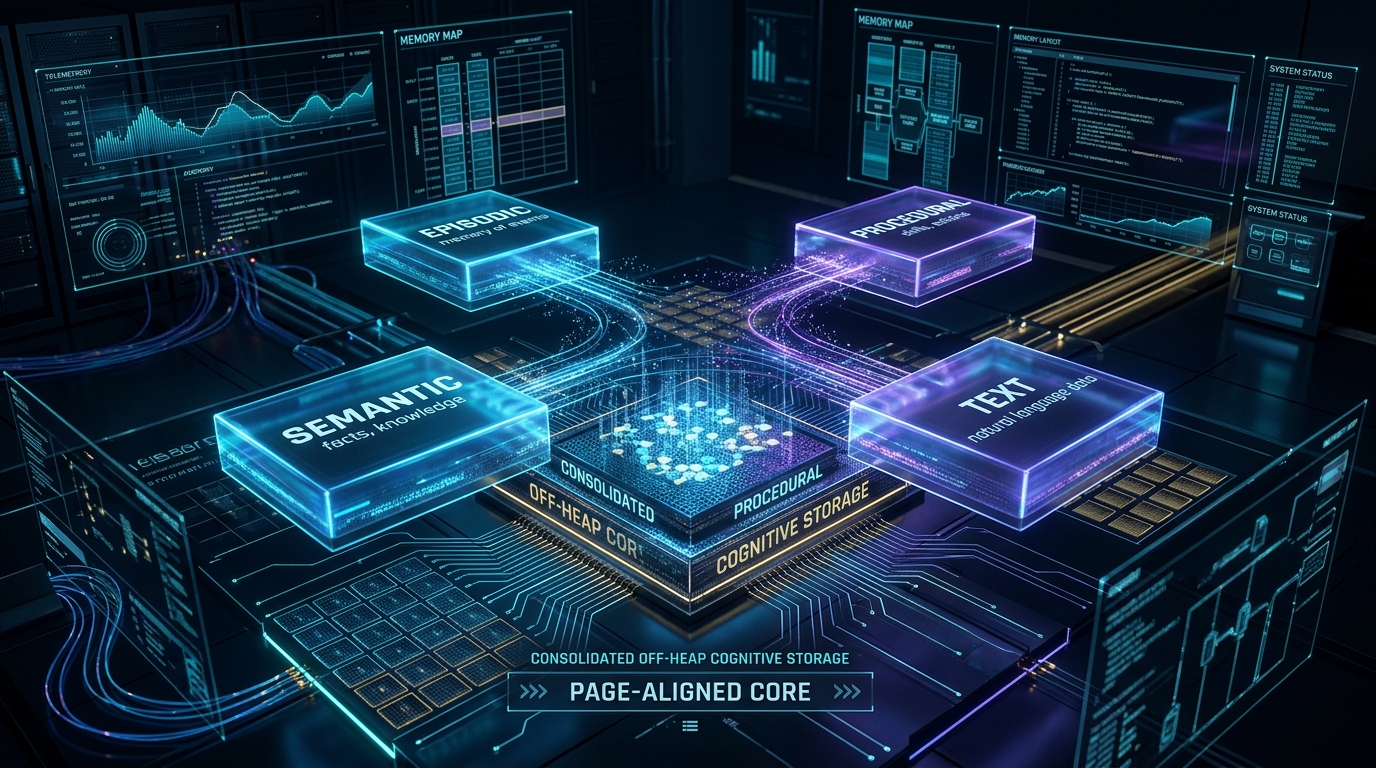
As autonomous AI agents scale from simple reactive bots to long-running, stateful production workers, they generate thousands of distinct memories. To ensure zero-GC overhead and sub-millisecond retrieval latencies, Spector stores these memories—spanning semantic vectors, episodic timelines, procedural rules, and raw conversation text—directly off-heap using Java 25's Foreign Function & Memory (FFM) API.
However, scaling this architecture hit a physical operating system limit: File Descriptor Exhaustion.
In this deep dive, we walk through how we redesigned Spector’s disk persistence layer, unifying multiple memory-mapped files into a single, page-aligned storage architecture, and how we built diagnostics to monitor off-heap fragmentation in real time.
The Bottleneck: File Descriptor Exhaustion
In our legacy storage architecture, each active partition required four distinct memory-mapped files:
semantic.mem— High-dimensional semantic vectors.episodic.mem— Time-series episodic records.procedural.mem— Rules and prompt instructions.text.dat— Raw text payloads.
Worse, the global state spanning the graphs and tracking indices required another ten files in the runtime directory:
hebbian.graph— Synaptic graph relationships.hypergraph.hyeg— Hyperedge entity connections.entity-directory.edir— Unique names and identities.coactivation.tracker— Synaptic co-activation patterns.temporal.chain— Chronological causality chain.index.midx/index.idpl— The master memory index and ID pool.
While memory-mapping these files via the OS kernel guarantees near-instant read latency, it consumes a file descriptor (FD) for each open file. When running a multi-tenant system sharded by namespaces and partition sequences, the OS file descriptor count escalated exponentially:
$$\text{Total Open FDs} = (\text{Tenants} \times \text{Partitions} \times 4) + (\text{Tenants} \times 10)$$
Under heavy load with $50$ tenants and $20$ partition rolls, the engine was forced to keep over $4,500$ active FDs open simultaneously. This quickly breached standard OS limits (ulimit -n), leading to catastrophic IOException: Too many open files crashes.
The Solution: Consolidated Storage Architecture
To solve this, we designed the Consolidated Storage Architecture. Instead of opening dozens of files, the engine now groups memory-mapped segments into two primary, unified .bundle files per tenant:
- Partition Bundle (
partition.bundle) — Consolidates the partition-scoped cognitive records (Semantic, Episodic, Procedural, and Text) into a single file per partition sequence. - Runtime Bundle (
runtime.bundle) — Consolidates all global indices, Hebbian graph matrices, and entity directories that persist across partition boundaries.
graph TD
subgraph Client Memory Space
A[Spector Memory Engine]
end
subgraph Master Virtual Segments
B[Partition Bundle Segment]
H[Runtime Bundle Segment]
end
subgraph Physical Disk Structures
C[partition.bundle file]
I[runtime.bundle file]
end
A -->|mmap| B
A -->|mmap| H
B -->|OS Page Cache| C
H -->|OS Page Cache| I
This reduces the open file descriptor count by exactly 75%, allowing the system to easily scale to thousands of namespaces without hitting OS limits.
Page-Alignment & Zero-Copy Slicing
For memory-mapped files to perform optimally, each logical region within the consolidated bundles must align perfectly with the operating system’s Virtual Memory Page Boundaries (typically 4096 bytes).
If a region starts on a non-page-aligned boundary, the OS cannot map it directly to hardware paging tables, causing CPU performance degradation and alignment faults during vector SIMD operations.
Slicing the Partition Bundle
The partition.bundle maps the active partition-scoped cognitive tiers. By wrapping them into a single file, the off-heap memory is divided into page-aligned offsets:
classDiagram
class PartitionBundle {
0x00000000 Magic Header (64 Bytes)
0x00000040 Bundle Sub-Header (64 Bytes)
0x00000080 Region Entry Directory
0x00001000 Semantic Region (Page-Aligned)
0x00A62000 Episodic Region (Page-Aligned)
0x00B6C000 Procedural Region (Page-Aligned)
0x00C76000 Text Region (Page-Aligned)
}
Slicing the Runtime Bundle
The runtime.bundle encapsulates the global memory indexing and graph representations, keeping the Hebbian CSR matrices, hypergraphs, and entity directory in a single, page-aligned segment:
classDiagram
class RuntimeBundle {
0x00000000 Magic Header (64 Bytes)
0x00000040 Bundle Sub-Header (64 Bytes)
0x00000080 Region Entry Directory
0x00001000 Working Memory Region
0x00003000 Hebbian Graph Matrix
0x000C8000 Hypergraph Connections
0x005E0000 Entity Directory
0x009F0000 Slot Index (index.midx)
0x00A90000 ID Pool (index.idpl)
0x00B50000 BM25 Term Index
}
Because these slices share the underlying memory backing of the master segment, there are zero heap allocations and zero byte copying operations when loading individual cognitive stores or traversing graphs.
Inspecting the Layout: Off-Heap Diagnostics
With multiple databases packed into a single binary file, checking database health requires custom introspection tools. We extended the spector-inspect CLI to support a dedicated bundle subcommand.
The inspect CLI reads the 64-byte BundleSubHeader and the RegionEntry directory to verify the bundle's integrity. It checks the magic header, calculates checksums, and decodes the inner headers of each region.
Measuring Space Fragmentation
Because regions are fixed in size inside a bundle, writing beyond a store's capacity requires relocating that region to the end of the file and expanding it, leaving a "DEAD" space gap behind.
To measure this, the inspect CLI computes the Off-Heap Space Fragmentation Ratio:
$$\text{Fragmentation Ratio} = \frac{\text{DeadAllocatedBytes}}{\text{TotalBundleSize}} \times 100\%$$
If this ratio exceeds a configured threshold (e.g., 20%), the CLI recommends triggering a database compaction routine to reclaim the wasted disk space.
Diagnostic Command Output
Developers can verify the layout of any partition bundle locally using the inspect tool:
===================================================================
Spector Memory Bundle Diagnostics: partition.bundle
===================================================================
Magic:              0x534D4B4D (SMKM)
Layout ID:          0x42554E44 ("DNUB")
Bundle Type:        0x53505442 ("BTPS")
Created At:         Tue Aug 04 23:57:23 UTC 2026
Regions Capacity:   4 max, 4 live
===================================================================
#  Region ID   Status Offset     Allocated  Capacity Stride Layout
-------------------------------------------------------------------
0  SEMANTIC    LIVE   0x00001000 10883072   10000    1088   COGN
1  EPISODIC    LIVE   0x00A62000 1089536    1000     1088   COGN
2  PROCEDURAL  LIVE   0x00B6C000 1089536    1000     1088   COGN
3  TEXT        LIVE   0x00C76000 33558528   0        0      BTXT
===================================================================
Fragmentation & Compaction Metrics
===================================================================
Live Regions Allocated: 46,620,672 bytes (44.46 MB)
Wasted Space (DEAD):    0 bytes (0.00 MB)
Fragmentation Ratio:    0.0%

[Optimal] No fragmented or DEAD regions detected. Bundle is compact.
===================================================================
Architectural Comparison: Legacy vs. Consolidated
The transition from single-file databases to page-aligned consolidated storage shows significant resource reductions:
| Metric | Legacy Storage | Consolidated Storage | Improvement |
|---|---|---|---|
| Open FDs per Partition | $4$ | $1$ | 75% Reduction |
| Open FDs per Runtime | $10$ | $1$ | 90% Reduction |
| Memory Allocators | $14 \times$ Arena |
$2 \times$ Arena |
85% Less Overhead |
| Page Fault Rate | High (Unaligned) | Zero (Page-Aligned) | Significant Latency Boost |
| Recovery Mechanism | Multi-File WAL Replay | Single unified WAL | Simpler Recovery Loop |
By unifying our off-heap structures, Spector delivers the performance of raw, hardware-level mapping with the safety and cleanliness needed to scale multi-tenant LLM systems.