
The Amygdala in Code: Emotional Valence Pinning for Safety-Critical AI Agents
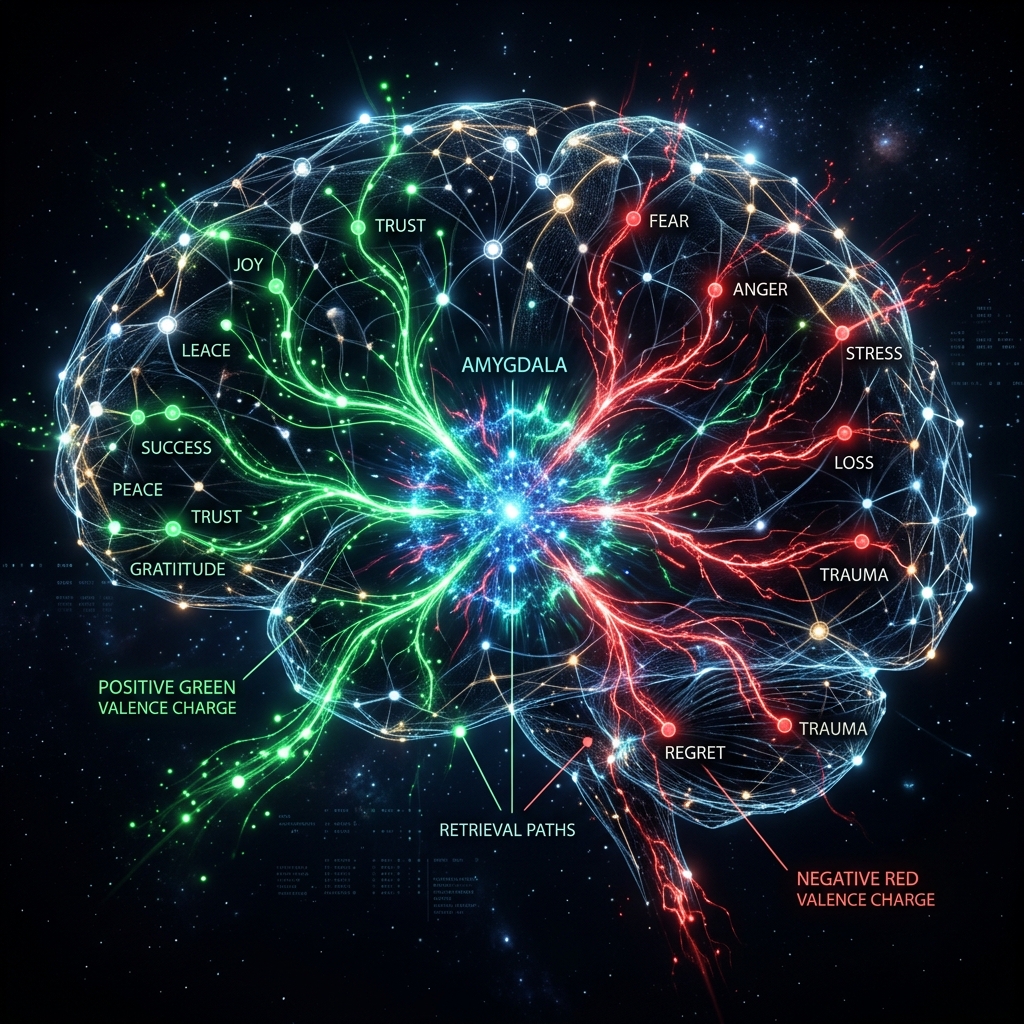
When a human experiences a significant event—such as touching a hot stove or receiving praise for a job well done—the brain's amygdala tags that experience with a strong emotional charge (positive or negative). This charge, known as emotional valence, alters the synaptic weight of the memory, ensuring it is recalled instantly in similar future situations to guide behavior.
In contrast, traditional AI agents have flat, emotionless memory logs. If an agent runs a faulty bash command that corrupts a database, or fails a security check, it treats that memory with the exact same weight as any other simple observation. Without expensive fine-tuning or prompt-bloated rule lists, it is highly likely to repeat the same error.
To solve this, we built Emotional Valence Pinning into Spector. In this article, we'll explain how it works and how it creates safer, self-correcting agents.
1. The Core Concept of Emotional Valence
In Spector, every memory record stored in the off-heap SMKM kernel contains a signed 8-bit byte for valence:
- Positive Valence ($+1$ to $+127$): Tags successful runs, helpful user feedback, correct code changes, and validated plans. Positive valence acts as a retrieval booster, pulling these "best practices" to the top of the context queue.
- Negative Valence ($-1$ to $-128$): Tags exceptions, user corrections, compile errors, and security violations. Negative valence acts as an "alert tag." When recalled, the agent is primed to analyze what went wrong and avoid repeating the mistake.
When a query is processed, Spector's spreading activation algorithm computes the final synaptic weight of a memory by combining its semantic similarity, its decay value, and its valence charge:
\[W_{final} = S_{similarity} \times R_{decay} \times (1 + \lambda V_{valence})\]
Where:
- $V_{valence}$ is the emotional valence score.
- $\lambda$ is the scaling factor of the cognitive profile (e.g., higher in "Cautious" profiles, lower in "Creative" profiles).
2. Real-World Scenario: Self-Correcting Bash Command execution
Let's look at how valence pinning prevents an agent from repeating a failure.
- Step 1: Failure occurs. The agent attempts to delete a file using an invalid syntax or unsafe flags (
rm -rf / path/to/dirwith an accidental space). The shell throws a validation or permission exception. - Step 2: Valence Pinning. The QA or system sentinel catches the failure and calls Spector's
memory_remembertool, assigning a high negative valence score:
await spector.remember({
  text: "Failed bash command execution: 'rm -rf / path/to/dir' caused a path separation syntax error. Danger of root directory deletion.",
  tier: "PROCEDURAL",
  source: "OBSERVED",
  tags: "bash,command-failure,safety-alert",
  interest: 1.0,
  urgency: 1.0,
  valence: -100 // High negative charge
});
- Step 3: Self-Correction. On the next turn, when the agent builds a plan to modify files, Spector detects the safety-alert context. Spreading activation retrieves the negative-valence memory and places it at the top of the agent's context window as an Admonition Warning.
- Step 4: Behavioral Shift. The LLM reads the warning, catches the syntax error in its draft plan, and corrects the command to
rm -rf /home/user/path/to/dirbefore execution.
graph TD
A[Agent Plans Action] --> B[Spector Recall Query]
B --> C{Active Amygdala Node?}
C -->|Yes, Neg. Valence| D[Inject Admonition Alert into Prompt]
C -->|No| E[Inject Normal Context]
D --> F[LLM Rewrites Plan to Avoid Mistake]
E --> G[LLM Executes Plan]
F --> G
3. Benefits of Valence Pinning
- Zero-Shot Self-Correction: Agents learn from errors instantly. No fine-tuning or retraining is needed.
- Dynamic Guardrails: Instead of hardcoding static regex filters, the system learns semantic safety rules from historical outcomes.
- Persona Modulation: By altering the valence scaling factor, you can easily transition an agent from a cautious, validation-heavy profile (highly sensitive to negative valence) to an exploratory, creative profile.
By bridging biological cognitive models with software, Spector creates agents that don't just execute tasks, but learn from their experiences.