
The Neuroscience of AI Identity: Mapping the Insular Cortex to Artificial Cognition
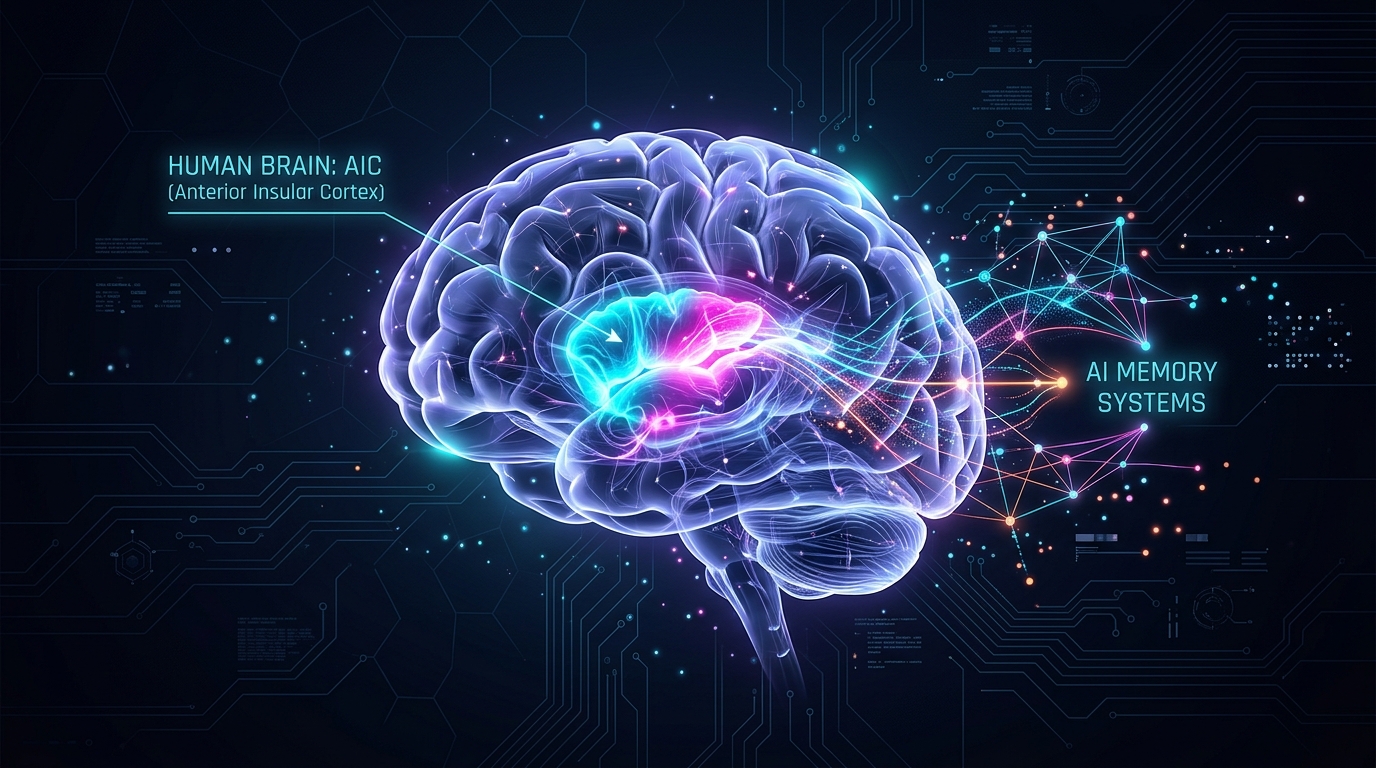
In both humans and artificial agents, identity is more than a static database record. It is a dynamic, self-aware core that filters how we interpret the world, shapes what we find important, and anchors who we are across changing contexts.
Historically, AI agent architectures have treated identity and memory as entirely separate domains. Long-term memories are stored in raw semantic vector databases, while the agent's identity—often referred to as the "Agent Soul" or persona—is treated as a flat text file (SOUL.md) or buried in traditional SQL configurations.
This creates a split crash domain and a "memory without judgment" problem. Cosine similarity alone cannot determine what is truly important to an agent.
To bridge this gap, we designed Spector, a biologically-inspired cognitive memory backbone. By mapping the functions of the human brain's Anterior Insular Cortex, we co-locate identity, active salience, and episodic memory inside a single, zero-copy off-heap memory container.
The Neuroscience of the Self
In neurobiology, self-awareness is not a single file; it is constructed at three distinct levels:
- The Proto-Self: Visceral, autonomic body states managed by the brainstem and hypothalamus. In Spector, this maps to the static system configuration.
- The Core Self: A transient, real-time sense of the "here and now." It dictates active interests, focus, and emotional baseline reactions.
- The Autobiographical Self: The high-level narrative identity containing past memories, relationships, and plans. This maps to our episodic and semantic memory regions.
In the human brain, the Anterior Insular Cortex (AIC) sits at the exact intersection of the Default Mode Network (DMN)—responsible for the autobiographical self ("who am I?")—and the Salience Network (SN)—responsible for active attention ("what matters to me?").
graph TD
DMN[Default Mode Network
Autobiographical Self] --> AIC{Anterior Insular
Cortex} SN[Salience Network
Active Attention] --> AIC AIC --> Identity["Core Identity / Agent Self-Model"] style AIC fill:#3498db,color:white,stroke:#2980b9,stroke-width:2px style Identity fill:#2ecc71,color:white,stroke:#27ae60,stroke-width:2px
Autobiographical Self] --> AIC{Anterior Insular
Cortex} SN[Salience Network
Active Attention] --> AIC AIC --> Identity["Core Identity / Agent Self-Model"] style AIC fill:#3498db,color:white,stroke:#2980b9,stroke-width:2px style Identity fill:#2ecc71,color:white,stroke:#27ae60,stroke-width:2px
Without the insula, there is no bridge between memory and meaning. It is the hub that translates raw sensory input into subjective, goal-directed importance.
Under the Hood: The Unified Memory Container
Rather than scattering files across directories or querying separate SQL databases, Spector aggregates all 11 cognitive and structural regions into a single memory-mapped container. The layout of this container is organized via a binary directory header that resolves region starts and bounds on startup:
┌──────────────────────────────────────────────────────────┐
│                   V4 BUNDLE DIRECTORY                    │
├──────┬──────────────────────┬─────────────┬──────────────┤
│ Slot │ Region ID            │ Start (Hex) │ Stride/Count │
├──────┼──────────────────────┼─────────────┼──────────────┤
│ 10   │ WORKING              │ 0x00000040  │ 64B / 100    │
│ 11   │ COACTIVATION         │ 0x00001000  │ Variable     │
│ 12   │ INDEX_MIDX           │ 0x00008000  │ 32B / 100K   │
│ 13   │ INDEX_IDPL           │ 0x00028000  │ 16MB         │
│ 14   │ HEBBIAN              │ 0x01028000  │ Variable     │
│ 15   │ TEMPORAL_CHAIN       │ 0x01828000  │ 24B / 10K    │
│ 16   │ TEMPORAL_FACTS       │ 0x01C28000  │ 16MB         │
│ 17   │ ENTITY_DIRECTORY     │ 0x02C28000  │ 64B / 50K    │
│ 18   │ ENTITY_NAMES         │ 0x03C28000  │ Variable     │
│ 19   │ HYPERGRAPH           │ 0x04C28000  │ Variable     │
│ 20   │ ENTITY_TYPES         │ 0x05C28000  │ 1MB          │
│ 21   │ RELATION_TYPES       │ 0x06C28000  │ 1MB          │
│ 24   │ INSULA               │ 0x07C28000  │ 64KB         │
└──────┴──────────────────────┴─────────────┴──────────────┘
The INSULA region is allocated a dedicated 64KB block at the tail of the container. Inside this block lives the agent's core self-model: its persona JSON, active attention weights, and emotional baselines.
Namespace Isolation: Separating User and Agent Selves
To prevent identity leakage and cognitive bleeding in multi-agent, multi-user deployments, Spector enforces strict isolation using namespaces.
Rather than sharing a single global memory space, every user and every agent is assigned a completely distinct namespace. Each namespace maps to an isolated directory on disk containing its own dedicated container file (e.g., user-456/runtime/runtime.bundle is completely separated from agent-123/runtime/runtime.bundle).
graph LR
UserNS["Namespace: user-456"] --> UserBundle["user-456/runtime.bundle"]
AgentNS["Namespace: agent-123"] --> AgentBundle["agent-123/runtime.bundle"]
UserBundle --> UserInsula["INSULA: User Self-Model"]
AgentBundle --> AgentInsula["INSULA: Agent Self-Model"]
style UserNS fill:#9b59b6,color:white
style AgentNS fill:#e67e22,color:white
This absolute separation guarantees that a user’s personal memories and an agent’s internal persona self-models never overlap at the physical file or memory-slice level.
When the system bootstraps a namespace, the corresponding container is loaded into memory in a single operation. This eliminates cold-starts and guarantees that each namespace's memory and identity share a single, isolated crash domain.
Active Salience: Scoring, Ranking, and Importance
A key innovation of this architecture is how the InsularCortex modulates the scoring and recall of all memories. Instead of retrieving context based solely on vector similarity, Spector filters recall through the active salience profile.
1. Numerical Stability for Novelty Detection
When a new memory is ingested, the system calculates its baseline novelty against existing vectors. To prevent numerical instability over millions of records, we use Welford's online algorithm to compute a running mean (\(\mu\)) and variance (\(\sigma^2\)) of nearest-neighbor distances.
We compute the z-score of the new memory's distance:
$$z = \frac{\text{distanceToNearest} - \mu}{\sigma}$$
This z-score is then mapped to a baseline importance score using a shifted sigmoid function:
$$\text{importance} = 0.05 + \sigma\!\left(1.2 \times (z - 1.0)\right) \times 9.95$$
This ensures that mundane, highly repetitive information is assigned a low importance baseline (\(\approx 0.05\)), while extreme outliers are flagged as "flashbulb" memories (\(\approx 10.0\)).
2. Salience Modulation in Recall
During the recall phase, the agent's current task-level priorities (stored in the InsularCortex self-model) are applied as a dynamic filter. The scoring pipeline follows a 6-phase sequence:
graph TD
Query[Recall Query] --> Sem[Semantic Retrieval
Vector Similarity] Sem --> Heb[Hebbian Association
Co-Activation Boost] Heb --> Temp[Temporal Linkage
Causal Sequencing] Temp --> Sal[Salience Filtering
Insula Weight Matrix] Sal --> Rank[Final Ranking &
Context Assembly] style Sal fill:#3498db,color:white,stroke:#2980b9,stroke-width:2px
Vector Similarity] Sem --> Heb[Hebbian Association
Co-Activation Boost] Heb --> Temp[Temporal Linkage
Causal Sequencing] Temp --> Sal[Salience Filtering
Insula Weight Matrix] Sal --> Rank[Final Ranking &
Context Assembly] style Sal fill:#3498db,color:white,stroke:#2980b9,stroke-width:2px
- Semantic Retrieval: Raw matches are fetched based on cosine similarity.
- Hebbian Association: Relational nodes are boosted using the off-heap co-activation matrix.
- Temporal Linkage: Causal chains are reconstructed to maintain chronological order.
- Salience Filtering: The
InsularCortexapplies a weight matrix that scales the score of memories containing specific entities or topics currently critical to the active task. - Ranking: The final context window is generated from the emotionally-charged, salience-weighted list.
By using the salience profile, the agent is able to ignore semantically matching but task-irrelevant memories, dramatically reducing context window clutter and LLM prompt costs.
Zero-Downtime Layout Self-Healing
Upgrading low-level binary layout structures on production systems is notoriously complex. If a new region (like the INSULA) is added to the memory container, legacy files on disk must be migrated without data loss.
Spector resolves this through a self-healing boot sequence:
sequenceDiagram
participant Boot as Startup Bootstrap
participant File as On-Disk Bundle
participant Memory as Off-Heap Layout
Boot->>File: Verify Bundle Header
alt Outdated Layout Detected
Boot->>File: Safe Close & Flush Legacy Stores
Boot->>File: Export Legacy Data to Temporary Buffer
Boot->>File: Delete Legacy File from Disk
Boot->>File: Create New Container with all 13 Regions
Boot->>Memory: Re-populate Slices from Buffer
Boot->>Memory: Initialize INSULA region with Default Persona
else Valid Layout
Boot->>Memory: Map Regions directly to Memory Slices
end
This guarantees that developer installations are upgraded transparently at startup, ensuring backward compatibility with older memory bundle formats while enabling immediate access to the insular cortex self-model.
Conclusion
By mirroring the neurological mapping of the human brain, we move beyond the limitations of flat vector retrieval. The integration of the insular cortex ensures that an agent's identity is not a static text file or a disconnected database row, but rather the living core through which all memory and attention flow.
Get Involved
Spector is open-source and built for the future of agentic AI.
- GitHub Repository: Explore the source code, open issues, and contribute at spectrayan/spector.
- Documentation: Read our full architecture guides, API references, and quick-start manuals at docs.spectrayan.com.