
The Namespace Fortress: Five Layers of Data Isolation That Make Cross-Tenant Leaks Physically Impossible
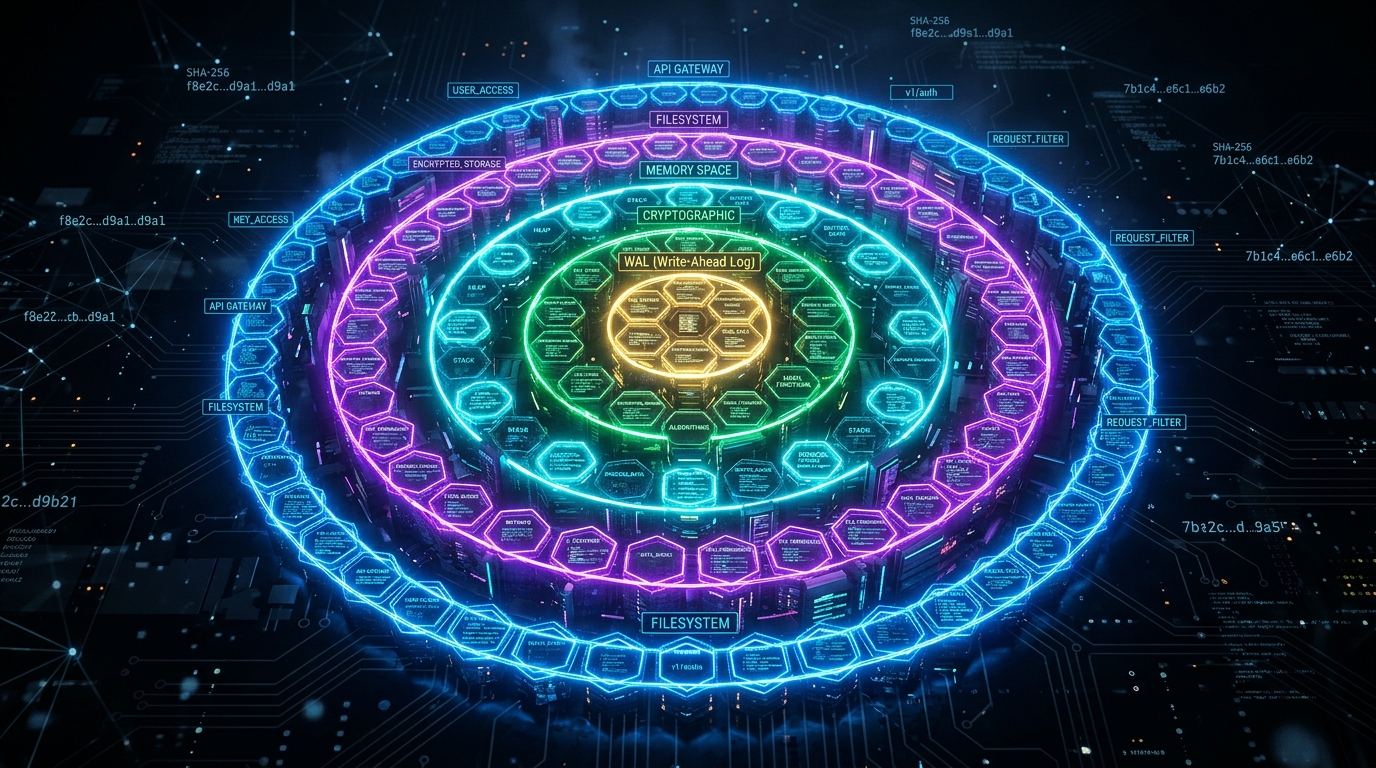
Most multi-tenant AI systems store everyone's data in one database, separated by a WHERE tenant_id = ? clause. One ORM bug, one SQL injection, one misconfigured backup — and every tenant's private memories are exposed.
Spector takes a fundamentally different approach. Every namespace gets its own physical universe — separate files, separate memory segments, separate encryption keys, separate crash-recovery logs. There is no shared state to leak.
This post walks through the five concentric isolation layers that make cross-tenant data leakage physically impossible in Spector's cognitive memory engine.
The Problem with Row-Level Security
Traditional multi-tenant databases use logical isolation — all tenants share tables, separated by a column:
-- Traditional: shared table, logical isolation
SELECT * FROM memories
WHERE tenant_id = 'hospital-a'
  AND user_id = 'dr-smith';

-- One WHERE bug exposes EVERY tenant
This creates fragile trust boundaries:
| Risk | Traditional DB | Spector |
|---|---|---|
| WHERE clause bug | All data exposed | Impossible — no shared table |
| DBA sees plaintext | Every tenant | Only their namespace |
| Backup contains | All tenants | One namespace |
| One key compromised | Entire database | One user |
Spector eliminates these risks by never co-locating data in the first place.
Layer 1: Filesystem Isolation
The first boundary is physical: each namespace gets its own directory tree on disk.
graph TB
subgraph "Namespace: agent-alpha"
A0["namespace.json"]
A1["runtime/"]
A2["working.mem"]
A3["index.midx"]
A4["entity-dir.edir"]
A5["partitions/"]
A6["semantic.mem"]
A7["text.dat — encrypted"]
A8["wal/ segments"]
A1 --> A2
A1 --> A3
A1 --> A4
A5 --> A6
A5 --> A7
A5 --> A8
end
subgraph "Namespace: agent-beta"
B0["namespace.json"]
B1["runtime/"]
B5["partitions/"]
B1 --> B2["working.mem"]
B1 --> B3["index.midx"]
B5 --> B6["semantic.mem"]
B5 --> B7["text.dat — encrypted"]
B5 --> B8["wal/ segments"]
end
A6 -.-x|"No shared files"| B6
The SpectorNamespaceManager creates these directory trees atomically on namespace creation. Each NamespaceContext holds its own root directory, config, and quotas. There is no shared directory, no shared file, and no shared state between namespaces.
Namespace discovery at startup scans the namespaces/ directory and loads each recognized directory (containing a namespace.json) into a ConcurrentHashMap — guaranteeing thread-safe, isolated access.
Layer 1b: Directory Traversal Prevention
Before any path resolution, every namespace ID passes through a pure validation guard called validateNamespaceId(). This is a side-effect-free check that never touches the filesystem:
flowchart LR
INPUT["Incoming namespace ID"] --> NULL{"null / blank?"}
NULL -->|Yes| REJECT["❌ Reject"]
NULL -->|No| LENGTH{"length > 256?"}
LENGTH -->|Yes| REJECT
LENGTH -->|No| CHARS{"Contains / \\ . or control chars?"}
CHARS -->|Yes| REJECT
CHARS -->|No| ACCEPT["✅ Proceed to path resolution"]
This single validation method blocks an entire class of attacks:
| Attack Vector | Blocked Character | Example |
|---|---|---|
| Directory traversal | /, \ |
../../etc/passwd |
| Parent escape | . |
../secret-namespace |
| Null byte injection | \u0000 |
agent\u0000admin |
| Control char abuse | U+0001–U+001F | Hidden path manipulation |
The guard is called before every namespaceDir(), namespaceDirSharded(), and tenantNamespaceDirSharded() invocation. Because it is a pure function with no filesystem side effects, no TOCTOU race conditions are possible.
Layer 2: Off-Heap Memory Isolation
Spector stores vectors in memory-mapped off-heap regions via Java 25's Panama Foreign Function & Memory API. Each namespace gets its own Arena and MemorySegment:
graph TB
subgraph "Namespace: agent-alpha"
A1["Arena.ofShared()"]
A2["MemorySegment — semantic.mem"]
A3["MemorySegment — working.mem"]
A1 --> A2
A1 --> A3
end
subgraph "Namespace: agent-beta"
B1["Arena.ofShared()"]
B2["MemorySegment — semantic.mem"]
B3["MemorySegment — working.mem"]
B1 --> B2
B1 --> B3
end
A2 -.-x|"Cannot access"| B2
A3 -.-x|"Cannot access"| B3
The PartitionManager maintains a ConcurrentHashMap<String, PartitionContext> keyed by namespace ID. Each partition maps its own .mem files into its own Arena via FileChannel.map().
Panama's Arena semantics enforce isolation at the JVM level: a MemorySegment allocated from one Arena cannot be accessed by code holding a different Arena's scope. The JVM itself prevents cross-namespace memory access — no application-level guards needed.
This means that even if a bug in Spector's application logic tried to read another namespace's vectors, the Panama runtime would throw an IllegalStateException before any bytes could be accessed.
Layer 3: Cryptographic Isolation
Each namespace gets its own AES-256-GCM Data Encryption Key (DEK), managed through envelope encryption:
graph LR
subgraph "KMS — Vault / AWS / Azure"
KEK["Master KEK"]
end
subgraph "Namespace: dr-smith"
DEK1["DEK — AES-256"]
T1["text.dat ← encrypted"]
W1["wal/*.bin ← encrypted"]
E1["entity names ← encrypted"]
S1["synaptic tags ← HMAC blind index"]
end
subgraph "Namespace: dr-jones"
DEK2["DEK — AES-256"]
T2["text.dat ← encrypted"]
W2["wal/*.bin ← encrypted"]
E2["entity names ← encrypted"]
S2["synaptic tags ← HMAC blind index"]
end
KEK -->|"wraps"| DEK1
KEK -->|"wraps"| DEK2
DEK1 --> T1
DEK1 --> W1
DEK1 --> E1
DEK1 --> S1
DEK2 --> T2
DEK2 --> W2
DEK2 --> E2
DEK2 --> S2
Spector exposes a DataEncryptor SPI (Service Provider Interface) that pluggable encryption implementations can satisfy. The OSS distribution ships with a NoopDataEncryptor by default. Enterprise deployments inject a KMS-backed encryptor that derives a unique DEK per namespace.
The encryption is applied at different tiers depending on access patterns:
| Data Type | Encryption | Scope |
|---|---|---|
Raw text (text.dat) |
AES-256-GCM | Per-namespace DEK |
| WAL payloads | AES-256-GCM | Per-namespace DEK |
| Entity graph names | AES-256-GCM | Per-namespace DEK |
| Synaptic tags | HMAC-SHA256 blind index | Per-namespace key |
Vectors (.mem) |
LUKS / BitLocker / EBS | Infrastructure layer |
Vectors remain at the infrastructure encryption tier because application-level decryption would degrade SIMD vector search performance by ~1,500× (decrypting 300MB of vectors per query vs. the ~20µs zero-copy search path).
Compromising one namespace's DEK reveals only that namespace's data. All other namespaces remain encrypted with different keys.
Layer 4: WAL (Write-Ahead Log) Isolation
Each namespace maintains its own WAL directory with encrypted segments:
graph TB
subgraph "Namespace: agent-alpha"
AW["wal/ directory"]
AW1["wal-000001.bin"]
AW2["wal-000002.bin"]
AW3["wal-000003.bin"]
ADEK["🔑 alpha's DEK"]
AW --> AW1
AW --> AW2
AW --> AW3
ADEK -.->|"encrypts"| AW1
ADEK -.->|"encrypts"| AW2
ADEK -.->|"encrypts"| AW3
end
subgraph "Namespace: agent-beta"
BW["wal/ directory"]
BW1["wal-000001.bin"]
BW2["wal-000002.bin"]
BDEK["🔑 beta's DEK"]
BW --> BW1
BW --> BW2
BDEK -.->|"encrypts"| BW1
BDEK -.->|"encrypts"| BW2
end
AW -.-x|"Independent recovery"| BW
During crash recovery, Spector replays only the affected namespace's WAL segments. There is no shared WAL, no shared transaction log, and no risk of cross-namespace replay contamination.
If agent-alpha crashes mid-write:
- Spector scans
agent-alpha/partitions/*/wal/ - Replays uncommitted events using alpha's DEK
- Never touches
agent-beta's directory tree
This gives each namespace independent crash durability — one namespace's crash cannot affect another namespace's data integrity.
Layer 5: API & MCP Namespace Scoping
Every Spector MCP tool requires an explicit namespace parameter that isolates agent/user memory spaces:
sequenceDiagram
participant Agent as AI Agent
participant MCP as Spector MCP Server
participant NS as Namespace Resolver
participant Mem as Memory Engine
Agent->>MCP: memory_recall(query, namespace="dr-smith")
MCP->>NS: resolve("dr-smith")
NS->>NS: validateNamespaceId("dr-smith") ✅
NS-->>MCP: NamespaceContext → /data/namespaces/dr-smith/
MCP->>Mem: recall(query) scoped to dr-smith's partition
Mem-->>MCP: Results from dr-smith ONLY
MCP-->>Agent: Scoped results
Note over Agent,Mem: dr-jones' data is never loaded, never queried, never visible
The MCP server also accepts a --namespace CLI flag for process-level isolation, ensuring the entire server instance is locked to a single namespace.
No MCP tool can access data across namespace boundaries. The namespace is resolved before any memory operation executes, ensuring that even a compromised agent cannot query another namespace's memories.
Scaling: Hash-Sharded Namespaces
At >50K namespaces, flat directory listing becomes an O(N) bottleneck. Spector solves this with SHA-256 hash sharding:
graph LR
subgraph "Flat Layout — up to 50K"
F1["namespaces/agent-alpha/"]
F2["namespaces/agent-beta/"]
F3["namespaces/agent-gamma/"]
end
subgraph "Sharded Layout — scales to 1M+"
S1["namespaces/a3/f7/agent-alpha/"]
S2["namespaces/b2/1c/agent-beta/"]
S3["namespaces/d1/e8/agent-gamma/"]
end
F1 -.->|"SHA-256 hash"| S1
F2 -.->|"SHA-256 hash"| S2
F3 -.->|"SHA-256 hash"| S3
The sharding algorithm takes the first 4 hex characters of SHA-256(namespaceId) and splits them into two 2-character directory levels — creating 256 × 256 = 65,536 buckets:
| Scale | Layout | Entries per Directory |
|---|---|---|
| ≤50K | Flat | Up to 50,000 |
| 100K | Sharded | ~1.5 per bucket |
| 1M | Sharded | ~15 per bucket |
Multi-tenant deployments add a tenant tier above the namespace, sharding on the tenant ID:
graph TB
subgraph "Tenant: acme-corp"
direction TB
T1["namespaces/xx/yy/acme-corp/"]
T1A["dr-smith/"]
T1B["dr-jones/"]
T1 --> T1A
T1 --> T1B
end
subgraph "Tenant: hospital-b"
direction TB
T2["namespaces/4a/c1/hospital-b/"]
T2A["nurse-lee/"]
T2B["therapist-kim/"]
T2 --> T2A
T2 --> T2B
end
T1A -.-x|"Fully isolated"| T2A
This produces paths like namespaces/xx/yy/acme-corp/dr-smith/ — tenant-scoped, hash-sharded, and fully isolated.
The Complete Defense Model
graph TB
subgraph "Layer 5: API Boundary"
API["MCP namespace parameter
Every tool call is scoped"]
end
subgraph "Layer 4: WAL Isolation"
WAL["Per-namespace WAL directory
Encrypted segments, independent recovery"]
end
subgraph "Layer 3: Cryptographic Isolation"
CRYPTO["Per-namespace AES-256-GCM DEK
Envelope encryption via KMS"]
end
subgraph "Layer 2: Memory Isolation"
MEM["Per-namespace Panama Arena
Separate MemorySegment, no shared pool"]
end
subgraph "Layer 1: Filesystem Isolation"
FS["Per-namespace directory tree
Hash-sharded, traversal-validated"]
end
API --> WAL --> CRYPTO --> MEM --> FS
Each layer is independently sufficient to prevent most cross-tenant leaks. Together, they form a defense-in-depth architecture where all five boundaries must be simultaneously breached for data to leak between namespaces.
Threat Model
| Threat | Layer | Mitigation | Status |
|---|---|---|---|
| SQL injection / ORM bug | 1 | No shared database — filesystem isolation | ✅ |
| Directory traversal | 1b | validateNamespaceId() blocks /, \, . |
✅ |
| Buffer overflow / mmap leak | 2 | Separate Panama Arena per namespace | ✅ |
| Disk theft / file exfiltration | 3 | Per-namespace AES-256-GCM encryption | ✅ |
| WAL replay attack | 4 | WAL encrypted with namespace DEK | ✅ |
| Rogue agent querying others | 5 | MCP namespace scoping on every call | ✅ |
| DBA accessing user data | 3 | BYOK — user's key never stored by Spector | ✅ |
| Backup exposing all tenants | 1 | Each namespace backs up independently | ✅ |
| Key compromise | 3 | Per-namespace DEKs — one key = one user | ✅ |
Why This Matters for AI Memory
AI memory systems hold some of the most sensitive data in an organization: conversations, decisions, reasoning traces, medical interactions, legal analyses. Unlike traditional databases where data is structured and queryable, AI memory is unstructured, context-rich, and deeply personal.
A cross-tenant leak in an AI memory system doesn't just expose rows — it exposes thought processes, decision patterns, and private conversations. The stakes are higher, and the isolation must be stronger.
Spector's namespace fortress ensures that every agent's cognitive memory is as isolated as if it were running on a separate machine — because at the filesystem, memory, and cryptographic layers, it effectively is.
Spector is open-source cognitive memory for AI agents. Explore the codebase at github.com/spectrayan/spector.