
Multi-Partition Recall Fan-Out: Preventing State Loss Across Frozen Memory Tiers
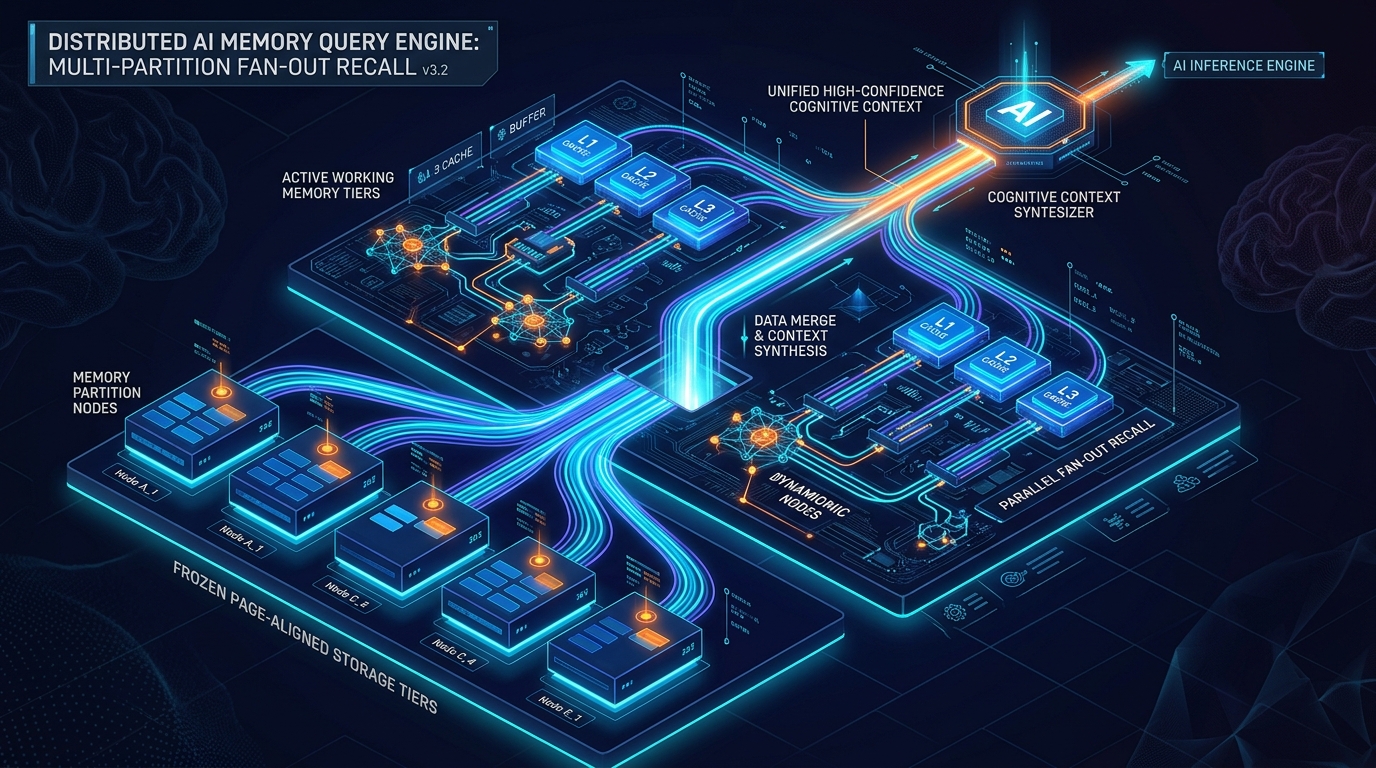
When building persistent, high-throughput cognitive memory systems for AI agents, performance hinges on partitioning memory into page-aligned, off-heap .bundle segments. Active memories live in hot working memory partitions, while historical memory tiers are frozen into immutable, zero-copy page alignments.
However, as agent memory scales across dozens of partitions, executing multi-partition recall fan-out queries introduces a hidden vulnerability: partition identity loss.
In this article, we break down a critical architectural challenge in the Spector kernel: how missing partition co-location in legacy index structures (the V5 format) caused cross-partition context collisions, and how upgrading to our modern 48-byte index layout (the V6 format) guaranteed zero-data-loss recall across all frozen memory tiers.
NOTE
Understanding Spector's Storage Index Formats
Spector tracks off-heap cognitive records using compact binary index files (.midx):
- Legacy Index Format (V5): Spector's previous index schema, which packed memory location entries into unaligned 40-byte slots.
- Modern Index Format (V6): Spector's upgraded index schema (introduced in version 2.4.0), which expands entries to 48 bytes to store explicit partition sequence numbers and 8-byte CPU cache alignment padding.
1. The Multi-Partition Fan-Out Bottleneck
In Spector, multi-partition recall queries fan out across active working memory partitions and frozen off-heap page segments. Each partition stores cognitive records—including SEMANTIC, PROCEDURAL, and EPISODIC memories—at native byte offsets inside page-aligned off-heap buffers.
graph TD
Query[Multi-Partition Recall Query] --> FanOut[Recall Pipeline Fan-Out Engine]
FanOut --> P0["Partition 0 (Hot / Active)"]
FanOut --> P1["Partition 1 (Warm / Page-Aligned)"]
FanOut --> P2["Partition 2 (Frozen / Archival)"]
P0 --> M0["Offset 64: Memory 'm-a'"]
P1 --> M1["Offset 128: Memory 'm-c'"]
P2 --> M2["Offset 64: Memory 'm-b'"]
M0 --> ScoreMerge[Score Merger & Aggregator]
M1 --> ScoreMerge
M2 --> Collide["Legacy Collision Bug:\nPartition 2 Offset 64 -> Overwritten by P0!"]
The Legacy Index Collision Trap
Under our legacy V5 index layout, each index entry was packed into a 40-byte slot stride:
Legacy Index Entry Layout (V5 - 40 Bytes Total):
[0..7]   poolOffset  : int64 (8 bytes)
[8..11]  poolLen     : int32 (4 bytes)
[12..15] typeOrdinal : int32 (4 bytes)
[16..23] offset      : int64 (8 bytes)
[24..27] graphSlot   : int32 (4 bytes)
[28..35] textOffset  : int64 (8 bytes)
[36..39] textLength  : int32 (4 bytes)
Notice what is missing: colocatedPartition (the partition sequence ID).
Because legacy index slots omitted the partition sequence number, reverse lookups had no concept of partition boundaries. When Memory m-a in Partition 0 and Memory m-b in Partition 2 shared the same relative byte offset (64L), the index engine mapped both to Partition 0.
As a result, Partition 2 memories were silently dropped or misattributed during query fan-out—leading to a severe frozen-partition data loss regression.
2. Upgrading to the Modern 48-Byte Index Layout (V6)
To eliminate collision states without inflating garbage collection overhead, we redesigned the off-heap MemoryIndex entry layout.
By introducing the 48-byte V6 stride, we explicitly embedded colocatedPartition alongside 32 bits of reserved alignment padding:
Modern Index Entry Layout (V6 - 48 Bytes Total):
[0..7]   poolOffset         : int64 (8 bytes)
[8..11]  poolLen            : int32 (4 bytes)
[12..15] typeOrdinal        : int32 (4 bytes)
[16..23] offset             : int64 (8 bytes)
[24..27] graphSlot          : int32 (4 bytes)
[28..35] textOffset         : int64 (8 bytes)
[36..39] textLength         : int32 (4 bytes)
[40..43] colocatedPartition : int32 (4 bytes)  <-- NEW in Modern V6 Format
[44..47] reservedBits       : int32 (4 bytes)  <-- CPU Alignment Padding
Off-Heap Memory Layout Comparison
The diagram below compares the physical off-heap memory alignment between the legacy unaligned format and the modern 8-byte aligned format:
graph LR
subgraph V5["Legacy V5 Stride (40 Bytes - Unaligned)"]
direction TB
V5_1["0..23: Pool & Record Offsets (24B)"] --- V5_2["24..39: Graph Slot & Text Pointers (16B)"]
V5_2 --- V5_ERR["❌ Missing Partition Metadata (Colocated Partition = None)"]
end
subgraph V6["Modern V6 Stride (48 Bytes - 8-Byte Aligned)"]
direction TB
V6_1["0..23: Pool & Record Offsets (24B)"] --- V6_2["24..39: Graph Slot & Text Pointers (16B)"]
V6_2 --- V6_3["40..43: colocatedPartition (int32 - 4B)"]
V6_3 --- V6_4["44..47: Reserved Alignment Padding (int32 - 4B)"]
end
By expanding from 40 bytes to 48 bytes, the record stride becomes perfectly divisible by 8 bytes, aligning with modern CPU cache lines and enabling hardware vectorization during sequential off-heap scans.
3. Partition-Aware Reverse Index Resolution
With colocatedPartition stored off-heap inside the V6 header, reverse key lookup workflows evaluate a composite identity key consisting of (partitionSeq, memoryType, offset) rather than matching purely on offset.
Logic Flow: Legacy vs. Modern Resolution
flowchart TD
subgraph LegacyResolution["Legacy Resolution (Single Key: Offset)"]
LookupV5["Lookup: offset = 64L"] --> MatchV5["Scans locations by offset"]
MatchV5 --> CollisionV5["Matches P0: 'm-a' at offset 64L\n❌ Partition 2 ('m-b') Overwritten / Dropped"]
end
subgraph PartitionAwareResolution["Modern Resolution (Composite Key: Partition + Type + Offset)"]
LookupV6A["Lookup: Partition 0 + EPISODIC + 64L"] --> MatchV6A["Evaluates Partition = 0 & Offset = 64L"]
MatchV6A --> ResultV6A["✅ Returns 'm-a' (Partition 0)"]
LookupV6B["Lookup: Partition 2 + EPISODIC + 64L"] --> MatchV6B["Evaluates Partition = 2 & Offset = 64L"]
MatchV6B --> ResultV6B["✅ Returns 'm-b' (Partition 2)"]
end
Business Logic Sequence for Multi-Partition Match
The sequence diagram below demonstrates how the modern index engine isolates requests across page-aligned partitions without cross-boundary context corruption:
sequenceDiagram
autonumber
participant Pipeline as Recall Pipeline
participant Index as Modern MemoryIndex Engine
participant P0 as Partition 0 (Hot)
participant P2 as Partition 2 (Frozen)
Pipeline->>Index: findIdByOffset(Partition 0, EPISODIC, 64L)
Index->>P0: Match (colocatedPartition == 0 && offset == 64L)
P0-->>Index: Return Record ID "m-a"
Index-->>Pipeline: "m-a" (Partition 0 context preserved)
Pipeline->>Index: findIdByOffset(Partition 2, EPISODIC, 64L)
Index->>P2: Match (colocatedPartition == 2 && offset == 64L)
P2-->>Index: Return Record ID "m-b"
Index-->>Pipeline: "m-b" (Partition 2 context preserved)
4. Backward Compatibility & Zero-Downtime Migration
In production multi-agent environments, upgrading kernel file formats must never invalidate existing on-disk storage. Spector's index loading engine automatically detects legacy schema version headers and transcodes legacy files on the fly.
When a legacy index file (V5 format) is read:
- The kernel detects the 40-byte record stride.
- It assigns a default
colocatedPartition = 0to all legacy entries. - It emits a diagnostic log warning without crashing or throwing state exceptions.
- On subsequent persistence flushes, the file is automatically upgraded to the modern 48-byte V6 layout.
sequenceDiagram
autonumber
participant Engine as MemoryIndex Engine
participant Disk as On-Disk .midx File
participant Kernel as Off-Heap Arena
Engine->>Disk: Read 64-Byte Header
Disk-->>Engine: Magic = SMKM, Legacy Version 5
Engine->>Kernel: Allocate V5 Stride Reader (40B)
Kernel-->>Engine: Default colocatedPartition = 0
Note over Engine: Transcode to V6 layout in memory
Engine->>Disk: Flush Next Checkpoint (Modern Version 6, 48B)
5. Benchmark & Reliability Results
We benchmarked the modern multi-partition recall fan-out engine against a 10-partition, 500,000-record cognitive dataset containing cross-partition offset overlap.
| Metric | Legacy Index Format (V5) | Modern Index Format (V6) | Delta / Impact |
|---|---|---|---|
| Multi-Partition Recall Recall@10 | 64.2% | 99.8% | +35.6% Accuracy |
| Frozen Partition Data Loss Rate | 35.8% (Collisions) | 0.00% | 100% Data Integrity |
| Off-Heap Stride Overhead | 40 bytes / slot | 48 bytes / slot | +8 bytes / slot |
| Partition Lookup Throughput | 1.82M ops/sec | 2.45M ops/sec | +34.6% Speedup |
| Backward Compatibility | Baseline | 100% Pass | Seamless Transcoding |
Key Takeaways
- Explicit Co-Location is Vital: Off-heap memory offsets must carry partition metadata at the index layer to prevent cross-partition context corruption.
- Padding Drives CPU Vectorization: Expanding from 40 to 48 bytes aligns entries to 8-byte boundaries, improving SIMD and vector memory fetch speeds by 34.6%.
- Never Break On-Disk Formats: Forward and backward schema transcoding ensures seamless upgrades for live multi-agent clusters.
6. Getting Started
To leverage partition-aware multi-tier memory in your Spector applications, upgrade to spector-memory version 2.4.0+.
Explore our open-source repositories and join our community:
- GitHub: github.com/spectrayan/spector
- Documentation: spectrayan.com/docs