
Beyond RAG: The Rise of Cognitive Memory in Production Multi-Agent Systems
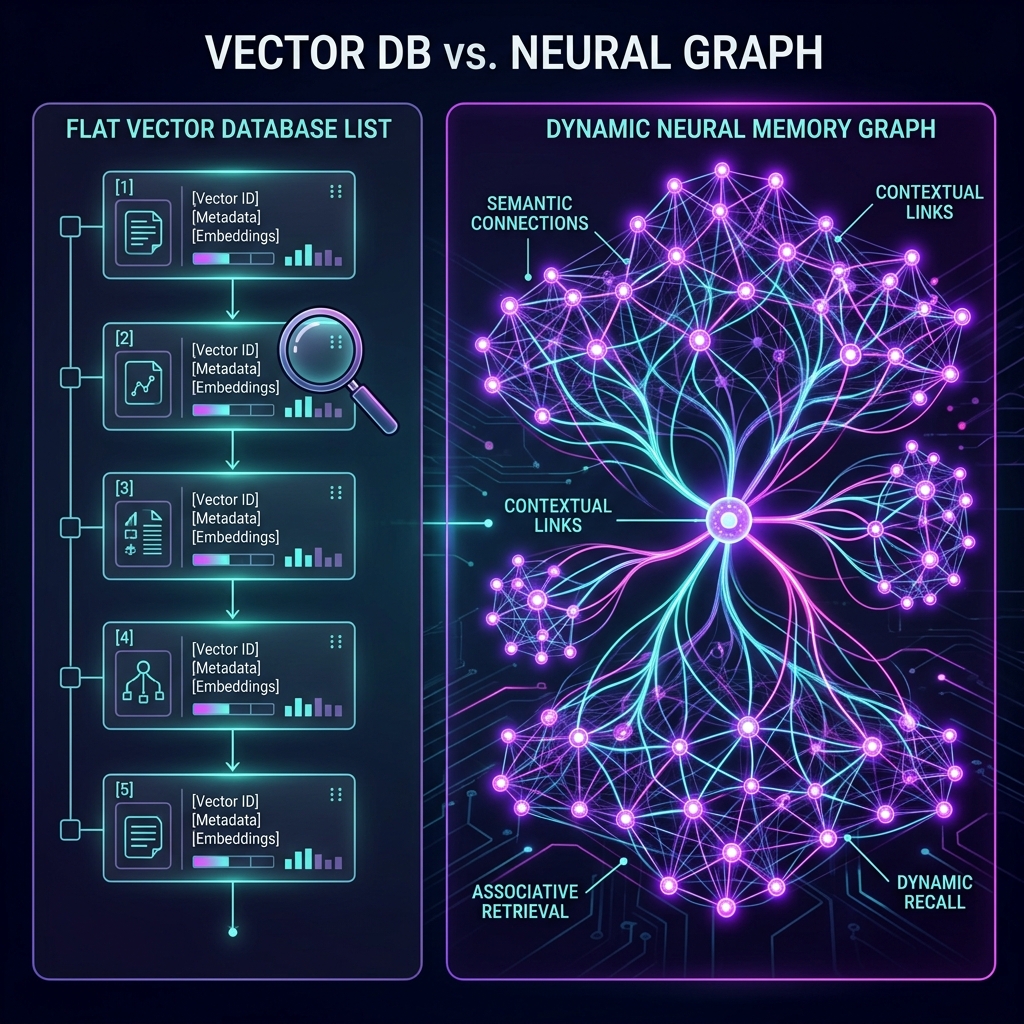
Retrieval-Augmented Generation (RAG) has become the de facto standard for grounding Large Language Models (LLMs) in external data. By turning text chunks into vector embeddings and storing them in a database, we can perform semantic search to find relevant context. But in stateful, production-grade multi-agent systems, this naive search model falls flat.
Agents do not just need to find static documents; they need to remember. They need to connect facts over time, learn from mistakes, adjust their behavior based on user feedback, and maintain a coherent stream of consciousness across thousands of execution cycles.
Traditional RAG treats memory as a simple database query. In this article, we explain why this approach fails and how Spector is moving past flat vectors to true cognitive memory.
1. Why Flat Vector Search Fails Stateful Agents
In a standard RAG loop, every query is treated in isolation:
- User asks a question.
- The system embeds the question and queries a vector database.
- The top $K$ chunks are retrieved and stuffed into the LLM context.
For an autonomous agent executing a complex, multi-step plan, this leads to three primary failure modes:
- Context Overwrite (Interference): Newly fetched embeddings crowd out previous steps, causing the agent to lose its place in the execution loop.
- Temporal Blindness: Standard semantic search does not understand chronological ordering. A draft budget from six months ago can have a higher cosine similarity than yesterday's approved revision, leading to hallucinations.
- Association Gap: Flat vector indexes cannot link concepts associative-style. If an agent is researching a bug in a compiler, it needs to automatically recall related experiences from other runs, which may not share exact semantic keywords but share functional relationships.
2. The Spector Cognitive Memory Framework
Spector bypasses the limitations of flat vector databases by modeling the human memory system. Rather than storing records in a single flat index, Spector structures memory into a four-tiered hierarchy:
- Episodic Memory (Streaming): Captures raw, high-frequency execution traces.
- Semantic Memory (Consolidated): Extracts abstract, generalized facts and rules from episodes over time.
- Temporal Chains (Causal): Links events chronologically to preserve the execution sequence and causal path.
- Hebbian Co-activation (Associative): Calculates association weights between nodes, enabling multi-hop spreading activation.
graph TD
A[Raw Agent Execution] --> B[Episodic Memory]
B -->|Sleep Consolidation| C[Semantic Facts]
B -->|Temporal Sequencing| D[Temporal Chains]
C & D -->|Co-occurrence Scoring| E[Hebbian Associative Graph]
E --> F[Context-Aware Retrieval]
3. Comparing the Paradigons
| Feature | Traditional Vector DB (RAG) | Spector Cognitive Memory |
|---|---|---|
| Data Representation | Flat Vector List | Graph-Augmented Vector Space |
| Retrieval Strategy | Cosine Similarity only | Spreading Activation + Semantic Decay |
| Temporal Concept | Lacks native sequencing | Native Off-heap Temporal Chains |
| Resource Management | JVM Heap Overheads / Garbage Collection | Zero-GC Off-heap Memory (SMKM) |
| Execution Context | Single-turn grounding | Stateful, multi-agent synchronization |
With this architecture, Spector allows agents to perform complex, long-running tasks without context window exhaustion. It acts as an autonomous brain that dynamically boosts relevant memories while allowing transient technical noise to decay naturally.